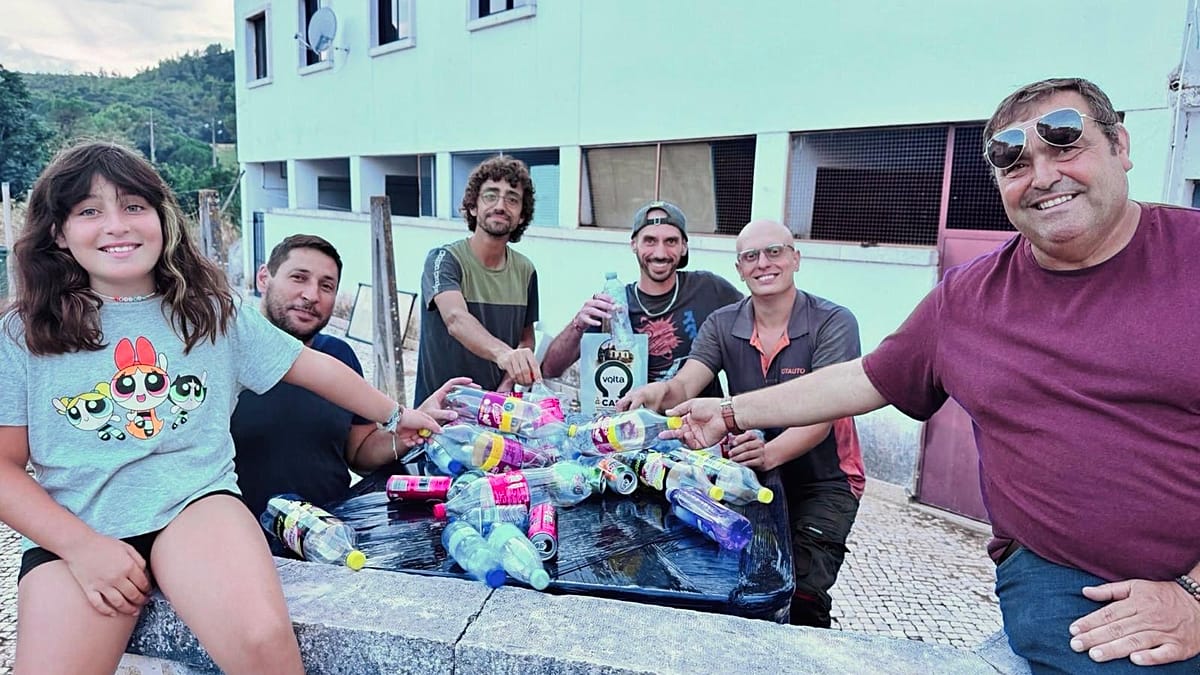
Sisters Ariela and Alice had already been using Portugal's bottle return scheme to earn money but since June they have upped the ante: now instead of just returning their own bottles, they are asking their neighbours' for their plastic waste and making money off that too. Since April this year, when the Volta scheme launched, plastic bottles in Portugal have a €0.10 deposit added to the cost. If you return the empty bottle to a supermarket with a Volta machine, you're given a receipt which can be exchanged for discounts or cash.
Ariela and Alice have big plans for their cash: Alice, who is ten, wants to do a three-week exchange in South Korea. Her sister Ariela, 13, wants to do the same in the United States "They wrote little letters and I printed them with their project and the time when they were going to collect the bag," explains their mother, Karina Lauro, who moved to Portugal from Rio de Janeiro in 2024. "They leave the bag at people's doors and every day, at nine o'clock in the evening, they go back to pick up that bag with the bottles, when there are any." The empty bottles are then exchanged for money.
With a clear goal: by June next year they aim to collect 120,000 bottles so they can make €6,000 each. It was the girls who came up with the idea of using Volta to raise funds and to involve the neighbours, after their mother warned them that just using the bottles from home would not make them much money. "It was very little, wasn't it?
Because it was just the bottles from our house," says Karina Lauro. "Basically, if it were only us, there would be no way." A post shared by Alice 10 🇰🇷 Ariela 13 🇺🇸 (@sonhonagarrafa) With Volta, plastic bottles of up to three litres now carry a deposit charge of ten cents. This money can then be reclaimed if the bottles are returned.
The bottles are returned via machines installed in supermarkets, which issue a receipt that can be converted into discounts or cash. Kiosks are also starting to appear in other busy locations or to process large quantities of bottles. This system, run by SDR Portugal, is the country's way of responding to the Single-Use Plastics Directive (DSUP), which requires 90 per cent of deposit bottles to be collected by 2029.
The directive allows European Union countries to set up deposit systems in order to reach this target. In Portugal, the system was rolled out in April. And as consumers were getting used to it, reports began to appear of bins being rummaged through and rubbish on the ground left by people looking for bottles.
Extract — continue reading at the source.