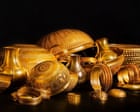
Thieves in Spain have raided the Treasure of Villena – a stunning collection of bronze age gold artefacts that has been described as the most important prehistoric trove in Europe – in the latest high-profile smash-and-grab heist on the continent. The raid on Thursday morning of the 66 mostly gold objects in the Spanish town of Villena lasted just minutes, officials said. The operation was “super-fast and super-professional”, the spokesperson said.
Local media said the few items the thieves had left behind included three silver vessels, a bracelet and some of the ornamentation of the bastón del reyezuelo, the “Kingfisher staff”, a prehistoric ceremonial scepter. Cerdán said: “We are absolutely devastated, I’m even trembling. The truth is that for those of us from Villena, this destroys us.
It’s part of our heritage, of our wealth.” The treasure, which was discovered in 1963 by the archaeologist José María Soler in a vessel sunk in a dried-out riverbed in Villena, included 29 bracelets, 11 bowls, three bottles and other miscellaneous pieces dating back to about 1000BC. It immediately became the main attraction of a small architectural museum in the province of Alicante. Since May 2024, the hoard has been on display in a specially designated room in the newly opened, municipally owned Villena Museum.
The unusual material of some of the items has long intrigued researchers. Though mainly gold, some pieces are also made of silver, iron, amber and a dark leaden material covered in a ferrous-looking oxide. A recent study published in the journal Trabajos de Prehistoria claimed that these items were probably forged from rare meteoritic iron.
While the treasure’s value is incalculable, the gold alone is worth about €1.7m (£1.45m), according to the mayor. The thieves arrived in several vehicles and apparently entered the museum through a window, according to the Spanish government’s deputy representative in Alicante, Manuel Pineda. Shortly before the robbery, another alarm went off at the city’s sports centre, and authorities were now investigating whether that was a diversion created by the thieves, the spokesperson added.
Mauro Hernández, a professor of archaeology at the University of Alicante and an expert on the treasure, told the broadcaster Cadena SER that the operation showed signs of prior planning. There have since been a series of brazen raids in institutions across Europe. Four works “of extraordinary value” by the Renaissance artist Antonello da Messina were stolen from a museum in Sicily, Italy’s culture ministry said last Sunday.
Extract — continue reading at the source.


