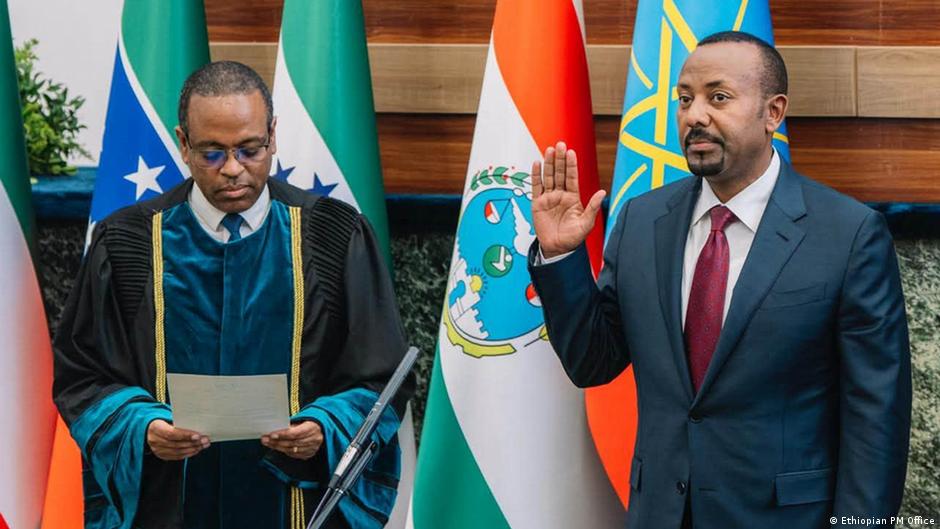
Amid escalating conflict in Ethiopia's northernmost Tigray region, Abiy Ahmed has been sworn in for another term as Prime Minister of Ethiopia. Shortly after the ceremony on Monday afternoon, Abiy reiterated his will to work toward giving the landlocked country direct access to the Red Sea. "Based on the principle of give and take, we will work diligently to ensure that Ethiopia has an outlet to the sea," Abiy said, a remark that risks exacerbating tensions with neighboring Eritrea.
The two countries have been at odds over Ethiopia's desire to control Eritrea's port of Assab. DW correspondent Solomon Muchie, who followed the swearing-in ceremony in Addis Ababa, said despite the renewed mandate, Abiy faces challenging times ahead. "The new term gives Prime Minister Abiy Ahmed stronger political authority," Solomon said.
"But the country's complex internal and regional challenges could make it difficult to translate the authority into lasting stability." Sunday's meeting in Cairo of countries that opposed Ethiopia was a case in point, Munchie said. "The leaders of Egypt, Eritrea, Somalia and Sudan discussed regional issues, but Ethiopia was excluded from this meeting, so this is also what Prime Minister Abiy Ahmed's government will face in his tenure in the coming years." For analyst Abdurahman Sayed, who leads the London-based Horn of Africa Center for Regional Integration, Eritrea now faces an imminent threat of entering the war in Tigray. This comes after a three-year Ethiopian campaign to gain control of the port of Assab.
"Eritrea has legitimate concern of Ethiopia's intentions to occupy [the country] if it can, and then if not, then at least take the port of Assab, which is a very important port, not only for commercial purposes but also strategically," Sayed said. "It oversees the Bab el Mandeb [Strait], which is the southern entrance to the Red Sea. Now, without that port, Eritrea's strategic significance would be reduced to almost nil, so there wouldn't be any importance of Eritrea." Last week, Ethiopia severed its diplomatic ties with Eritrea and Egypt.
According to Sayed, this might be a sign that the government is determined to pursue its push for the Red Sea port by force. The renewed fighting in Tigray might point in that direction. Just days ago, the Ethiopian National Defence Forces took control of Tigray's capital, Mekelle.
On Monday, a pro-government media outlet reported that the Ethiopian army had begun mobilizing its troops towards the Eritrean border, following a movement of the opposed Tigray People's Liberation Front (TPLF) retreating to the area near Adigrat, an important gateway to Eritrea and the Red Sea. "The Tigrayan people have cultural, linguistic and religious links with those in southern Eritrea," Sayed said. "In fact, the ones in power in Eritrea have many more similarities with those in Tigray." He added that there could be a spillover effect, especially now that the TPLF is out of Mekelle, and they might be out of major towns as well.
Extract — continue reading at the source.