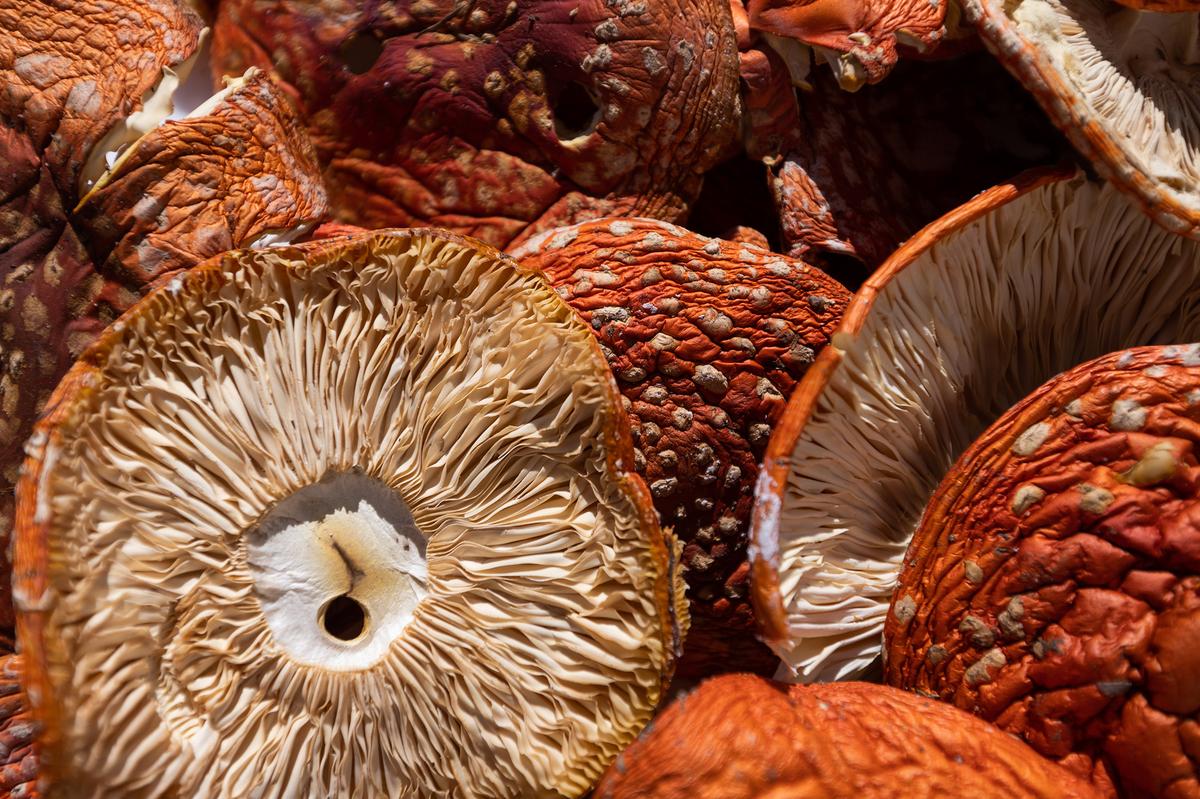
That phrase, magic mushrooms, usually calls to mind one type of mushroom: those containing psilocybin, the compound showing promise as a therapy for depression, addiction and other psychopathologies. But these gummies were not psilocybin. Instead, the packaging described Amanita muscaria, the red-capped, white-spotted toadstool of fairy-tale forests, iPhone keyboards and Super Mario.
I knew a little about the folklore of Amanita muscaria. I had first seen it discussed in an episode of the show Hamilton’s Pharmacopeia (2016-21), which begins with a claim I now hear often: that Amanita muscaria may be among the oldest human intoxicants. The New York banker-turned-ethnomycologist R Gordon Wasson, whose Life magazine essay from 1957 introduced psilocybin mushrooms to a mass Western audience, certainly took this idea seriously.
In his book Soma: Divine Mushroom of Immortality (1968), he argued that the Vedic soma – a ritual drink in ancient Indian religions – was made from Amanita muscaria. The mushroom has also been linked, sometimes carefully and sometimes wildly, to the origins of Santa Claus, Viking berserkers and even Christianity. Some believe its other name, ‘fly agaric’, stems from its use as a natural pesticide for house flies; the word muscaria is also derived from the Latin word musca, meaning fly.
Some scholars have linked Amanita muscaria to Lewis Carroll’s mushroom scene in Alice’s Adventures in Wonderland (1865), in which the Caterpillar tells Alice that ‘one side’ of the mushroom will make her taller and the other shorter, though Carroll does not identify a species. But I wasn’t standing in that smoke shop holding one of these products as a folklorist or looking to lose myself in Carroll’s ‘golden afternoon’. I am a public-health scientist, and my questions were pragmatic: what exactly was in this package?
Were these products legal? The first thing I did was what I usually do. I went to the scientific literature.
And down the rabbit hole I tumbled. Although manufacturers use the term ‘magic mushrooms’, the main psychoactive compound in Amanita muscaria is not pharmacologically interchangeable with psilocybin; the two drugs do not act on the brain in the same way. The body converts psilocybin into psilocin, the substance that actually produces its psychedelic effects.
Extract — continue reading at the source.