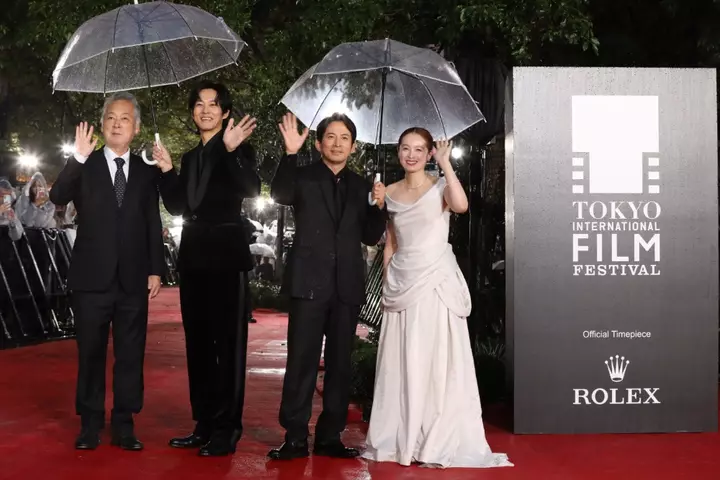
The opening film of the 39th Tokyo International Film Festival, Zeze Takahisa’s “Sukiyaki” tells the story of how the title tune became a worldwide hit in 1963 as well as a beloved standard that has been recorded in foreign-language versions that have also topped charts. The film goes beyond the song itself to delve into the lives and careers of its makers: lyricist Ei Roksuke (Matsuzaka Tori), composer Nakamura Hachidai (Okada Junichi), and singer Sakamoto Kyu (Nakano Taiga). They became known in Japan as the “689 trio” with the unusual moniker coming from the “number” characters in their names: Hachi (8), Roku (6) and Kyu (9).
But as the film shows in scene after highly charged dramatic scene, their professional and personal relationships were not always harmonious. Interviewed at the headquarters of Toho, the film’s Japan distributor, Zeze stressed the film’s relevance, six decades after “Sukiyaki,” known locally as “Ue o Muite Aruko” (I’ll Walk with My Head Up”), first hit the charts. Now Japan is absorbing fewer influences from abroad.
The culture used to be wide open – now it’s become narrower.” But younger Japanese are now discovering that energy from the Showa Era (1926-1989), the period of Emperor Showa’s reign, when Japanese pop culture was at a fertile peak. Together with nostalgic Boomers, they could be found in the audience of “Godzilla Minus One,” the 2023 smash hit Godzilla series installment set in the early postwar period . The follow-up by director Yamazaki Takashi, “Godzilla Minus Zero” is also at TIFF as the festival’s Centerpiece screening, “It’s a kind of Showa boom,” joked Zeze.
In casting “Sukiyaki,” he says, the main criterion was not a physical resemblance to its main characters, though Nakano Taiga channels Sakamoto’s exuberant stage persona with an uncanny precision. Also, when Sakamoto sings in the film, it’s Taiga’s voice you’re hearing – he has an amazing talent as a vocalist.” The film’s drama, though, centers more on Nakamura and Ei, who joined forces to compose a series of hits in the 1960s but quarreled and parted as Nakamura spiraled into alcoholism.
Extract — continue reading at the source.