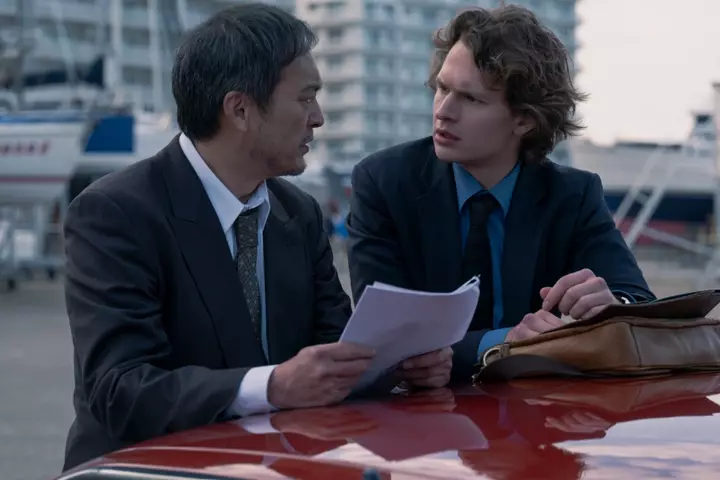
Boden, the London-based producer who spent almost two years in Japan making two seasons of HBO Max’s “Tokyo Vice,” traced the scheme from a 2020 research program, which “Tokyo Vice” supported, to the 2023 J-LOD incentive and today’s IP360, which offers 50% against Japanese spend. He said the minimum spend, raised to JPY800 million ($5.1 million), shut out independent films and co-productions, since most Japanese films cost between $1.5 million and $3 million. He also called for an automatic approval system in place of panel-based selection, which he said made Japan one of the few territories with a subjective incentive, at a time when projects can take three to five years to come together.
That’s the question, and we need a solution,” Boden said. He pointed to Martin Scorsese’s “Silence,” “Pachinko” and “Shōgun” as Japan-set projects that scouted in the country but shot elsewhere, and argued for building training into the incentive, citing the U.K.’s 0.5% ScreenSkills levy as a model. Since that rule took effect in June 2023, more than AUD20 million has gone into training, he said, while the average cost of an hour of Australian TV has climbed from AUD2 million ($1.4 million) to around AUD5 million–AUD6 million ($3.5 million–$4.2 million) over seven or eight years.
Muller welcomed signs that the Ministry of Economy, Trade and Industry (METI), which runs the incentive, was moving from single-year to two-year financing and raising maximum thresholds. Georgina Pope, head of production at Toho Tombo Pictures, whose recent Japan work includes A24’s “Marty Supreme” and “Monarch: Legacy of Monsters,” said permitting in Tokyo, while still difficult, was changing. Her team recently closed the road in front of Tokyo City Hall to stage a large car scene.
Boden said Japan was the hottest country in the world at the moment. The body, which the Japanese Prime Minister directly ordered, is meant to break down the silos between the ministries that each handle a piece of content policy: the Ministry of Internal Affairs and Communications, the Agency for Cultural Affairs, METI and, where overseas expansion is concerned, the Ministry of Foreign Affairs. The government aims to launch it in 2027.
The plan forms part of a public-private investment roadmap drawn up in July, which targets JPY20 trillion ($127 billion) in overseas sales by 2033. Content is one of 17 strategic fields in the growth strategy of Prime Minister Takaichi Sanae’s administration. For film, the roadmap covers support for luring large-scale location shoots, backing for international co-productions built on Japanese IP and tougher anti-piracy measures.
Amari Akira, the former Liberal Democratic Party secretary-general and METI minister, recalled chairing the parliamentary league behind Japan’s basic content law 22 years ago, with future prime minister Kishida Fumio as its secretary-general and Hayashi Yoshimasa running its secretariat. He joked that the lineup proved his foresight. The thinking was right, he said, but execution lagged and Japan fell behind Korea in taking its content overseas.
Extract — continue reading at the source.