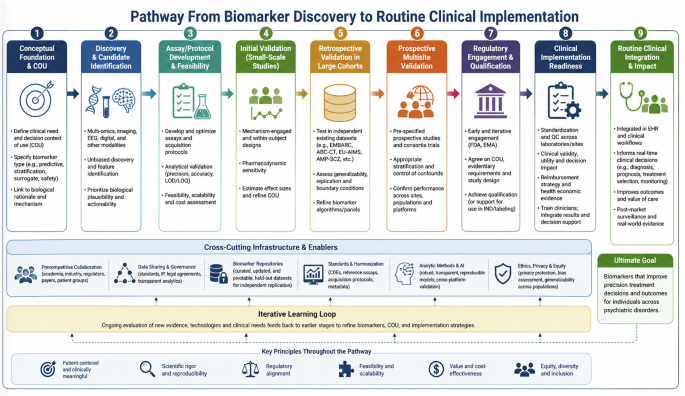
Psychiatric drug development remains constrained by diagnostic heterogeneity, insufficient and inconsistent drug response, high placebo response rates, and the absence of validated biomarkers that can reliably guide patient stratification, trial design, and regulatory decision-making. Despite substantial advances in neuroscience, few biomarkers in psychiatry have progressed beyond exploratory use, limiting the translation of mechanistic insights into effective therapeutics. The process of implementing biomarkers in psychiatry requires new levels of organization and coordination across many stakeholders, each with their own priorities.
To date, however, no comprehensive roadmap exists to align scientific, regulatory, clinical, and commercial stakeholders around the development and implementation of predictive biomarkers in psychiatry. This position paper, developed by the American College of Neuropsychopharmacology (ACNP) Precompetitive Stakeholder Task Force and informed by work from the European College of Neuropsychopharmacology (ECNP) on the Precision Psychiatry Roadmap, brings together key stakeholders to begin the process of engaging in coordinated efforts. By integrating scientific, regulatory, and commercial perspectives, we clarify biomarker definitions and contexts of use, review current FDA regulatory pathways and gaps, and synthesize lessons from real-world examples.
We highlight emerging biomarker modalities including fluid-based, digital, electrophysiological, neuroimaging, and multimodal approaches, and propose strategies to de-risk their adoption through standardized platforms, early regulatory engagement, and scalable trial designs. Emphasis is placed on precompetitive collaboration, large-scale data harmonization, and stakeholder alignment to accelerate reproducibility, regulatory interpretability, clinical utility, and improved use of experimental systems. This roadmap identifies actionable strategies to advance biomarker-enabled precision psychiatry and nurture cooperation, which will accelerate therapeutic innovation and improve clinical outcomes.
Psychiatric drug development continues to face major challenges, including diagnostic heterogeneity, high placebo response rates, and a lack of clearly defined mechanistic targets. Unlike in other therapeutic areas of medicine, clinical trials in psychiatry still predominantly enroll patients based on symptom checklists rather than pathophysiological criteria. For example, psychiatric symptoms such as anhedonia, cognitive dysfunction, and psychomotor slowing are observed across multiple psychiatric disorders and also manifest in neurodegenerative or systemic diseases, such as Parkinson’s disease, stroke, and lupus.
This cross-diagnostic overlap complicates the identification of specific clinical populations and impedes the development of targeted treatments [1, 2]. While there have been numerous attempts over the decades to identify biomarkers that could stratify patients based on likely response to specific pharmacologic mechanisms—or even predict placebo responsiveness—these efforts have yielded few clinically actionable tools [3,4,5]. Commonly investigated biomarkers such as cortisol, C-reactive protein (CRP), and mGluR (metabotropic glutamate receptor) genetic variants showed promise in biomarker discovery studies, but evidence was not replicated in larger interventional trials (Table 1).
Others, such as composite panels combining electroencephalogram (EEG), digital, and blood-based measures, remain hypothetical. Large-scale genetic efforts, such as the Psychiatric Genomic Consortium, have had numerous successes in identifying common variants associated with psychiatric disease; however, the identified variants to date do not carry strong predictive value or penetrance for the majority of patients. Note that there have been a limited number of highly penetrant variants with high positive predictive value in some classical neurodevelopmental disorders, as well as more recent data identifying potentially causal rare variants [6], but these genetic markers are only relevant for a very small percentage of the population suffering from psychiatric illness.
Extract — continue reading at the source.


