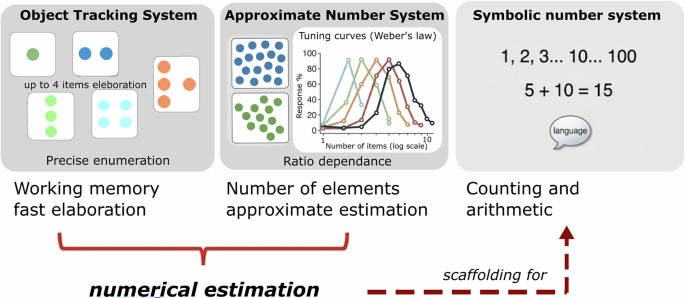
Number sense, the ability to estimate and compare numerical quantities, emerges early in development and is widespread across species. Despite decades of work on behavioural and neural correlates of numerosity, the genetic and mechanistic foundations remain poorly integrated. We propose a review and perspective that brings together evidence from vertebrates.
Our unique focus relies on how genetic variation, brain lateralisation, and neural circuit organisation across development shape number cognition. We highlight zebrafish (Danio rerio) and chicks (Gallus gallus) as complementary comparative models that can uncover conserved principles and novel mechanisms, opening new avenues for studying the biological bases of numerical cognition and its disorders from the very early developmental stages. When thinking about numerical cognition, one might naturally associate it with human mathematical abilities such as counting and calculation.
However, this represents only one aspect of a broader set of cognitive processes, which also includes more basic, non-symbolic mechanisms for processing quantities. In this context, number sense refers to the ability to estimate and compare numerical quantities, for example, the number of elements in a set (i.e., numerosity). This estimation is cross-modal, meaning it can operate across different sensory modalities (e.g., vision, audition, sensorimotor1,2,3), although in this review we will focus primarily on visual numerosity.
Number sense is a non-symbolic system that operates independently of formal mathematical knowledge and culturally acquired symbols4. In contrast, symbolic numerical systems, such as Arabic numerals or counting words, rely on learned associations between symbols and quantities and are predominantly human, although limited forms of symbolic-like competence have been reported in some non-human species (e.g., primates and parrots) following extensive specific training5,6. Within this framework, non-symbolic number sense is typically viewed as the developmental and evolutionary precursor that scaffolds the acquisition of more complex, symbolic numerical abilities in humans.
Consistent with this view, non-symbolic numerical cognition has been linked to later mathematical abilities7,8. It can be considered a core, evolutionarily conserved cognitive trait that emerges early in development and is observed in naïve animals as well as across a wide range of species9,10,11. General numerical abilities are widely acknowledged as important for survival and reproduction across many species12,13,14.
Distinguishing quantities allows animals to make efficient decisions in several contexts such as foraging15 and coordinating during cooperative hunting16. In social contexts, numerical skills support collective decision-making, including quorum sensing, and territory defense, avoiding costly intergroup conflicts17. In addition, enumeration also contributes to navigation18,19 and to antipredator strategies, as individuals can reduce predation risk by joining larger groups of conspecifics20.
Extract — continue reading at the source.


