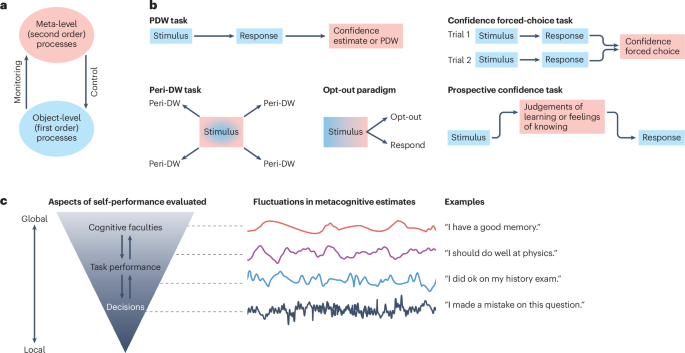
Metacognition enables organisms to self-evaluate their own cognitive processes. In humans, this capacity underpins adaptive learning, social coordination and the formation of self-beliefs about skill and ability. A core motif that underpins multiple forms of metacognition is the ability to form estimates of performance in a self-directed frame of reference, expressed as propositional confidence about one’s own behaviour and mental processes.
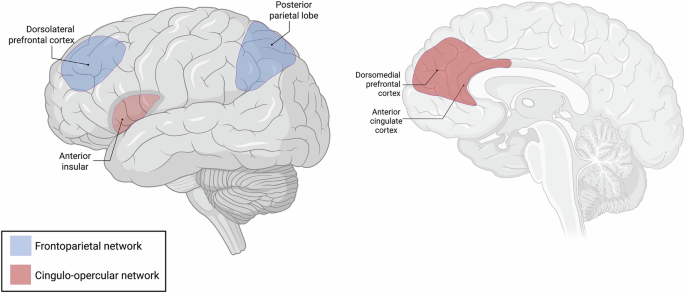
Convergent behavioural, computational and neural evidence obtained across rodents, non-human primates and humans indicates that these self-evaluations arise from structured transformations of uncertainty. Dynamic evidence accumulation processes provide candidate building blocks for local confidence, whereas multimodal prefrontal brain areas integrate these signals to support abstract, global self-beliefs. This architecture supports metacognitive control at multiple timescales, from rapid error correction to strategic task arbitration and social communication.
Dysfunctional metacognition can lead to disorders of reality monitoring and insight, in which erroneous mental representations are endorsed with aberrant confidence. By integrating computational, cross-species and clinical perspectives, metacognitive neuroscience offers a bridge from neural circuit mechanisms to subjective experience. This is a preview of subscription content, access via your institution Access Nature and 54 other Nature Portfolio journals Get Nature+, our best-value online-access subscription Receive 12 print issues and online access Prices may be subject to local taxes which are calculated during checkout Metcalfe, J. & Shimamura, A.
Metacognition: Knowing about Knowing (The MIT Press, 1994). Metacognition and cognitive monitoring: a new area of cognitive–developmental inquiry. Psychol. 34, 906–911 (1979).
This paper introduced metacognition as a distinct psychological construct, setting the agenda for research on its cognitive and neural basis. Flavell’s distinction between metacognitive knowledge and experience is a forerunner of global and local aspects of metacognition. A computational framework for the study of confidence in humans and animals.
This review sets out a normative computational framework for behavioural signatures of confidence, allowing metacognition to be quantified and studied using both explicit and implicit measures in humans and non-human animals. The study of animal metacognition. Visual metacognition: measures, models, and neural correlates.
Extract — continue reading at the source.