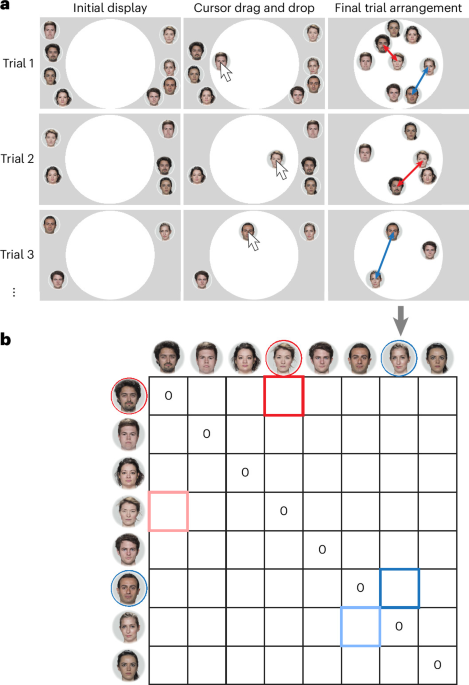
Previous research has typically elicited these judgements using specific words provided in advance by the experimenter (for example, ratings on competence or trustworthiness), raising questions about completeness (these tasks use a limited set of words) and generalizability (for example, across languages). Here we asked over 3,000 participants to spatially arrange unfamiliar faces based on perceived trait similarity, without providing any word labels. Using predominantly White faces, experiment 1 yielded five dimensions that we interpreted as approachability, gender-specific warmth, competence, morality and youthfulness.
Using White, Black and Asian faces, experiment 2 also produced five dimensions, which showed prominent effects of stereotypes associated with race. Comparisons with four other studies that used word labels argue that approachability or warmth emerges as a universal evaluative factor that integrates multiple trait facets (such as trustworthiness, warmth and competence) into a single holistic dimension and that race and gender stereotypes emerge depending on the set of face stimuli used. People readily infer psychological traits from faces (such as trustworthiness or competence; henceforth, face judgements), even when the faces are unfamiliar and devoid of any background knowledge.
These face judgements show good test–retest reliability within a participant, as well as consensus across participants1,2,3 (but see ref. 4 for cultural effects). Importantly, face judgements are often inaccurate and may reflect our biases and stereotypes more than true facts about the person5. Nonetheless, such face judgements are associated with social behaviour in the real world, sometimes with large consequences.
For example, the perceived competence of political candidates’ faces predicts election outcomes worldwide6,7,8 and face judgements causally influence individual voting behaviour9,10 and appear to have effects on dating choices, hiring decisions, science news communication and courtroom sentencing11,12,13,14,15. Understanding the mechanisms underlying face judgements has become a hot topic, with the literature spanning social psychology, political science, visual psychophysics, cognitive neuroscience and computer vision16. Perhaps the most reproducible finding across studies is the low-dimensional structure of these trait judgements.
It is widely believed that the hundreds of different face judgements people form can be summarized by just a few dimensions1,17. When people are asked to rate unfamiliar faces on a list of given trait words, a low-dimensional correlation structure is typically observed across the inferred traits. Dimensionality reduction analyses such as factor analysis then reveal two to four dimensions that are variably interpreted as warmth, competence, youthfulness, femininity or related concepts1,2,3,18.
Although there is broad agreement that a small number of dimensions capture most of the variance in people’s trait judgements, there is notable variation in the exact structure identified. For instance, Oosterhof and Todorov3 proposed a two-dimensional model of valence and dominance, whereas Sutherland et al.2 identified three dimensions and Lin et al.1 proposed four, with somewhat different interpretations of what these dimensions might mean. A fundamental challenge emerging across the studies is whether these results might be an artefact of the approach used.
Extract — continue reading at the source.


