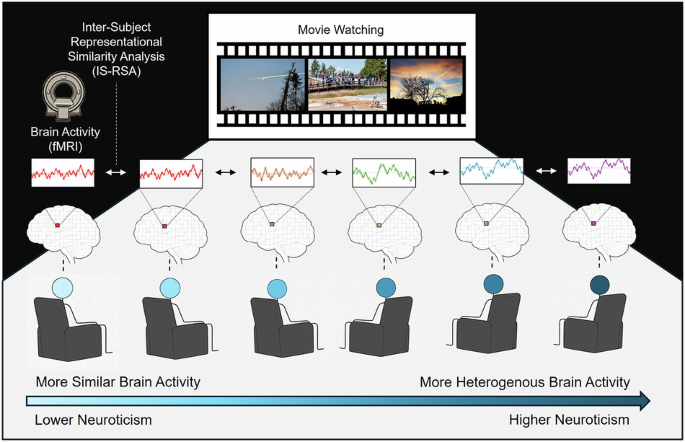
We applied Inter-Subject Representational Similarity Analysis on data from 174 Human Connectome Project participants to investigate if their similarity in neuroticism is reflected in their similarity of fMRI-recorded brain activity during movie watching. To test behavioral personality theories that consider trait expression as dependent on situational context, we examined whether brain-trait representational similarity varied between trait-relevant and trait-irrelevant movie scenes (independently rated, N = 86). Higher neuroticism was associated with greater heterogeneity in brain responses, a pattern that was particularly pronounced during trait-relevant scenes.
Our study informs dimensional conceptualizations of psychopathology viewing neuroticism as risk factor and extends behavioral personality theories to the level of brain function. Broadly, it highlights the value of naturalistic imaging and underscores the importance of stimulus selection when investigating brain-behavior associations. Neuroticism is a major dimension of human personality differences1,2.
It reflects the relatively stable individual tendency to experience negative affective and cognitive states associated with threat and punishment, such as anxiety, anger, and depressive symptoms3,4, qualifying it as a personality trait5. High neuroticism is a risk factor for many mental disorders, including anxiety, mood, and substance use disorders6,7,8. Understanding its neurobiological basis is therefore an essential goal of neuroscience research.
Genetic factors account for 30–60% of the variance in neuroticism9, indicating a substantial biological foundation. In interaction with environmental influences, this genetic basis contributes to variability in brain structure and function10, which is thought to underlie individual differences in this personality trait3,11,12. Specifically, this gene-environment interplay is thought to shape individual neuroticism levels by modulating neurobiological systems involved in affective reactivity, stress sensitivity, and regulatory control3,13,14,15,16, thus influencing how readily threat-related information captures attention, how strongly individuals experience negative affect in response to stressors, and how effectively cognitive control systems can downregulate emotional responses.
Corroborating this, neuroticism-related differences in information processing have been discovered17,18 and proposed to be mediated by attentional control mechanisms: according to the Attentional Control Theory (ACT)19 and to the Dual Mechanisms of Control Framework20, anxiety—a construct closely related to neuroticism21,22—reduces attentional control and impairs processing efficiency by, e.g., increasing internal distraction through worry and rumination. Specifically, low neuroticism is proposed to involve the top-down (proactive20) goal-driven system, involved in sustained representation of task-relevant goals, while high neuroticism is associated with the bottom-up (reactive20) goal-directed system, where transient representations are susceptible to disruption of worry-related thoughts. Accordingly, neuroimaging studies have identified structural and functional brain correlates of neuroticism primarily in limbic/subcortical (e.g., amygdala, hippocampus) and frontal regions (e.g., dorsolateral prefrontal cortex, anterior cingulate cortex)3,23,24,25, mapping onto aforementioned processes.
However, findings have been inconsistent across studies23,24,25. For example, neuroticism has been associated with both increased and absent gray matter volume differences in hippocampal regions25,26,27, as well as increased, unchanged, or decreased activation in limbic regions including the amygdala and hippocampus23,24,28,29. These inconsistencies likely reflect heterogeneity in sample characteristics, analytic or measurement choices, and task demands, as well as the multifaceted nature of neuroticism itself.
Extract — continue reading at the source.


