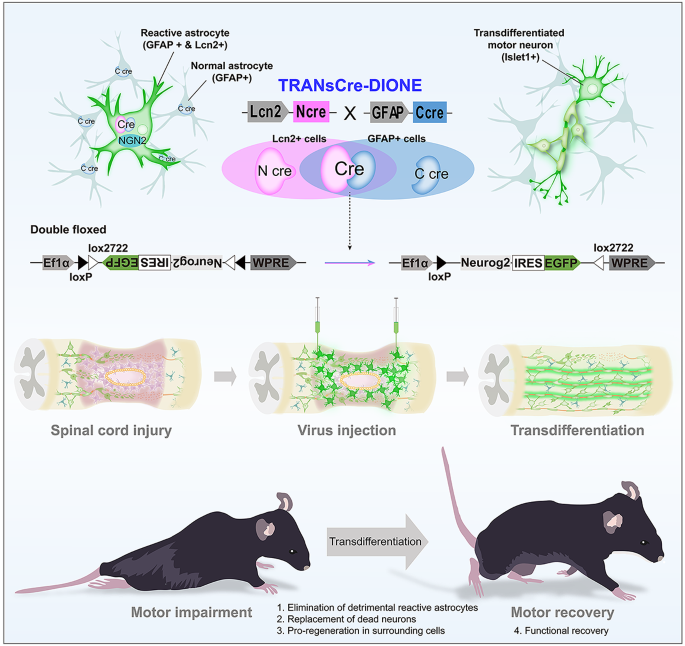
In spinal cord injury (SCI), the scar-forming reactive astrocytes with upregulated glial fibrillary acidic protein (GFAP) proliferate aberrantly near the injury site, representing a potential cellular source for transdifferentiation into neurons to replenish dead neurons. However, the conventional use of GFAP promoter to target reactive astrocytes has two inherent problems: inadvertent conversion of normal astrocytes and low efficiency due to progressive weakening of promoter activity during transdifferentiation. Here, we present TRANsCre-DIONE, a dual-promoter split-Cre system combining GFAP and Lcn2 regulatory elements with Cre-dependent Neurog2 expression under the EF1α promoter, enabling selective targeting of scar-forming reactive astrocytes.
This approach achieved 87% conversion efficiency and 96% specificity in vivo. After SCI, TRANsCre-DIONE caused transdifferentiation into Isl1-positive and ChAT-positive motor neurons, reduced astrogliosis, enhanced regeneration in surrounding cells, and a significant motor recovery. These findings suggest that TRANsCre-DIONE enables efficient and selective astrocyte-to-neuron conversion and represents a promising strategy for SCI repair.
Spinal cord injury (SCI) induces irreversible neuronal death and glial scar formation, which results in permanent motor and sensory dysfunction1,2,3. Although many attempts have been set forth to regenerate damaged spinal cord, currently doctors prescribe medications only to relieve pain to patients with SCI. Despite substantial efforts, therapeutic options remain largely limited to symptomatic management, and effective strategies for neuronal regeneration and functional restoration are still lacking4,5,6.
The much-hoped-for stem cell therapy still has a long way to go in clinics owing to its issues with low efficacy and safety. The safety issues include tumor formation, immune rejection, and unnecessary pain by reprogrammed neurons forming improper neural connections7,8. These serious risks are majorly caused by transplantation of induced stem cells, which still might have pluripotency9.
To overcome the limitations of transplantation, the concept of transdifferentiation or direct reprogramming of one type of differentiated resident cells into other cell types has been proposed9,10. It has been reported that diverse cell types, including fibroblast, microglia, and astrocyte, can be transdifferentiated into neurons using various transcription factors11,12,13,14,15. Among these cell types, the glial fibrillary acidic protein (GFAP)-positive astrocytes are known as the most abundant cell type in the brain16.
Under normal conditions, astrocytes provide various neurotrophic factors for neuronal growth and survival, regulate ionic homeostasis by taking up potassium ions and glutamate, and engage in synaptic transmission and plasticity by releasing gliotransmitters17. However, under pathological conditions such as in SCI, these normal astrocytes transform at the site of injury into reactive astrocytes and become hypertrophied and proliferative, especially under a severe condition18, to eventually form a glial scar19,20,21. The severely reactive astrocytes overexpress oxidizing enzymes such as MAO-B to cause oxidative stress and can adopt neurotoxic features under certain conditions22,23.
Extract — continue reading at the source.