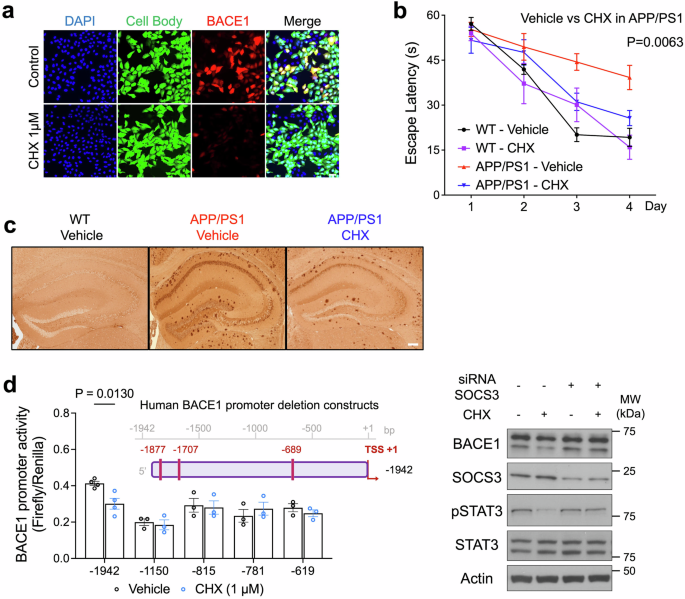
Excessive amyloid‑β (Aβ) production, driven by β‑site APP cleaving enzyme‑1 (BACE1), is central to the pathogenesis of Alzheimer’s disease (AD), yet active‑site BACE1 inhibitors have failed in trials because of efficacy and safety limitations. Targeting BACE1 transcription offers an orthogonal strategy that may enable partial, context‑dependent suppression compatible with neuronal function.1 We developed a ratiometric BACE1 promoter reporter (RFP under the human BACE1 promoter; GFP under CMV for internal normalization) and screened 1200 clinically used molecules (Prestwick). Chlorhexidine (CHX) emerged as the strongest suppressor of BACE1 promoter-linked reporter activity in this screen, with a clear dose–response, no detectable cytotoxicity, and no significant change in the action potential threshold at effective concentrations (≤1 µM) (Fig. 1a).
Because this reporter system was used as a screening tool rather than as stand-alone proof of promoter-specific regulation, candidate hits were further evaluated using endogenous BACE1 expression and APP processing readouts. In SH-swAPP cells, CHX reduced BACE1 levels and decreased the C99/C83 ratio, indicating reduced β-secretase-dependent APP processing. Together, these findings support the suppression of BACE1 expression and amyloidogenic processing under AD-relevant conditions.
To assess whether the BACE1-suppressing effect of chlorhexidine observed in vitro was associated with improvement in vivo, APP/PS1 transgenic mice and wild-type (WT) littermate controls were orally administered 10 mg/kg chlorhexidine per day from 9 months of age for 8 weeks. Throughout dosing, CHX-treated and control mice showed no significant differences in body weight or in locomotor activity during behavioral testing, with no overt signs of toxicity. CHX-treated APP/PS1 mice showed improved performance in the Morris water maze and passive avoidance tests (Fig. 1b).
In parallel, CHX was associated with reduced plaque burden in the cortex and hippocampus (Fig. 1c). CHX treatment also reduced BACE1 expression in the cortex of APP/PS1 mice and decreased the C99/C83 ratio, consistent with reduced amyloidogenic processing in vivo. To identify upstream mediators of BACE1 repression, we profiled hESC-derived neurons after CHX exposure.
RNA-seq and pathway enrichment analysis revealed a JAK1–STAT3–SOCS3-related response. Consistent with these findings, CHX no longer decreased phospho-STAT3 or BACE1 under SOCS3 knockdown, suggesting that the suppression of BACE1 by CHX involves a SOCS3-dependent pathway (Fig. 1d). Using BACE1 promoter reporters with serial 5′-deletions, the full-length construct (-1942 form), which contains three putative STAT elements, had the highest basal activity and was suppressed by CHX (to approximately 73% of the control at 1 µM), whereas deletion of the two distal elements reduced basal promoter activity and abolished the CHX response.
Together with earlier reports that JAK/STAT signaling can act on the BACE1 promoter,2,3 these data fit a working model in which CHX drives a SOCS3-dependent, JAK/STAT-responsive state that decreases STAT-driven BACE1 transcription. This work identifies CHX as a previously unrecognized chemical modulator emerging from a BACE1 regulatory screen and shows that CHX treatment is associated with reduced amyloid pathology and improved behavioral performance in APP/PS1 mice; these findings support the involvement of a SOCS3-dependent pathway in BACE1 suppression in hESC-derived neurons. In contrast to catalytic BACE1 inhibition, the modulation of BACE1 expression may provide an alternative route for partial suppression associated with pathological benefit.1,4 Given the established clinical use of CHX as an antiseptic and its pleiotropic pharmacology, CHX should be regarded here as a nonselective pharmacological probe rather than a repurposing-ready AD therapeutic.
Extract — continue reading at the source.


