Autism spectrum disorder (ASD) is highly heritable, and mutations in hundreds of genes have been implicated as individually rare causes of ASD1,2,3. Understanding how disruptions to these functionally diverse genes lead to the core features of ASD remains a major challenge4. Moreover, ASD is three- to four-fold more common in male than in female individuals5, and female autistic people tend to carry more autosomal risk alleles for ASD compared with their male counterparts6,7; however, the biological basis of this ‘female protective effect’ (FPE) has remained unknown8,9.
Here we show that individual perturbations of 18 ASD genes in human neural progenitor cells converge on shared effects on gene expression, including widespread downregulation of other ASD genes. De novo reconstruction of a gene regulatory network enabled identification of central transcriptional regulators that drive this transcriptomic convergence, including prominent ASD gene CHD8 and candidates including REST. Furthermore, X-linked transcription factor ZFX, which is expressed from both the active and the inactive X chromosomes in female individuals10, emerged as a key activator of many ASD genes: we propose that the higher ZFX expression level observed in the female brain can buffer damaging mutations in diverse ASD genes, contributing to the female protective effect.
Together, these results show how key gene regulatory networks can become broadly and similarly dysregulated upon disruption of individual ASD genes and provide molecular insight into the female protective effect in ASD. Large-scale genetic studies have implicated hundreds of genes in autism spectrum disorder (ASD), with many identified through rare mutations that result in loss of function of one allele1,2,3. This suggests that gene dosage plays an important part in ASD11 and makes it critical to determine how appropriate expression levels of ASD genes are maintained.
Characterization of gene regulatory networks (GRNs) could provide important insights into mechanisms mediating the proper transcriptional dosage of these ASD genes. In addition, ASD is significantly male-biased in prevalence, and although some ASD genes have been identified on the X chromosome12, X-linked mutations alone cannot fully explain this sex bias8,13. Moreover, it has been consistently demonstrated that female individuals require greater autosomal genetic risk to manifest ASD compared with male individuals6,7, but the genetic mechanisms of this female protective effect (FPE) are unknown8,9.
Here we use GRN reconstruction to identify key drivers of expression of ASD genes, including CHD8 and REST. These analyses also identify female-biased transcription factor ZFX, which is expressed from both the active and inactive X chromosome in female individuals10, as a key regulator of ASD genes, suggesting a direct transcriptional mechanism that could contribute to the FPE. This study provides a crucial framework for determining how variants in diverse genes can cause convergent molecular effects that ultimately result in ASD.
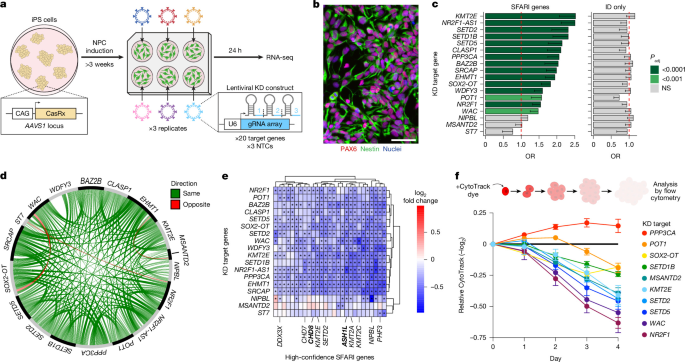
Functional interrogation of ASD genes revealed strongly overlapping effects on downstream targets in human neural progenitor cells (NPCs). Knockdown (KD) studies were performed for 20 ASD genes, including 18 genes from the Simons Foundation Autism Research Initiative (SFARI) gene database14 and two long non-coding RNAs (lncRNAs) previously implicated in ASD (NR2F1-AS1 (ref. 15) and SOX2-OT16). RNA-degrading CRISPR enzyme CasRx17 and an array of three guide RNAs (gRNAs) per target (Supplementary Table 1) were used to induce individual KD of each target gene relative to non-targeting controls (NTCs) in NPC cultures from a control human male (XY) induced pluripotent stem (iPS) cell line (Fig. 1a,b and Extended Data Fig. 1).
Extract — continue reading at the source.


