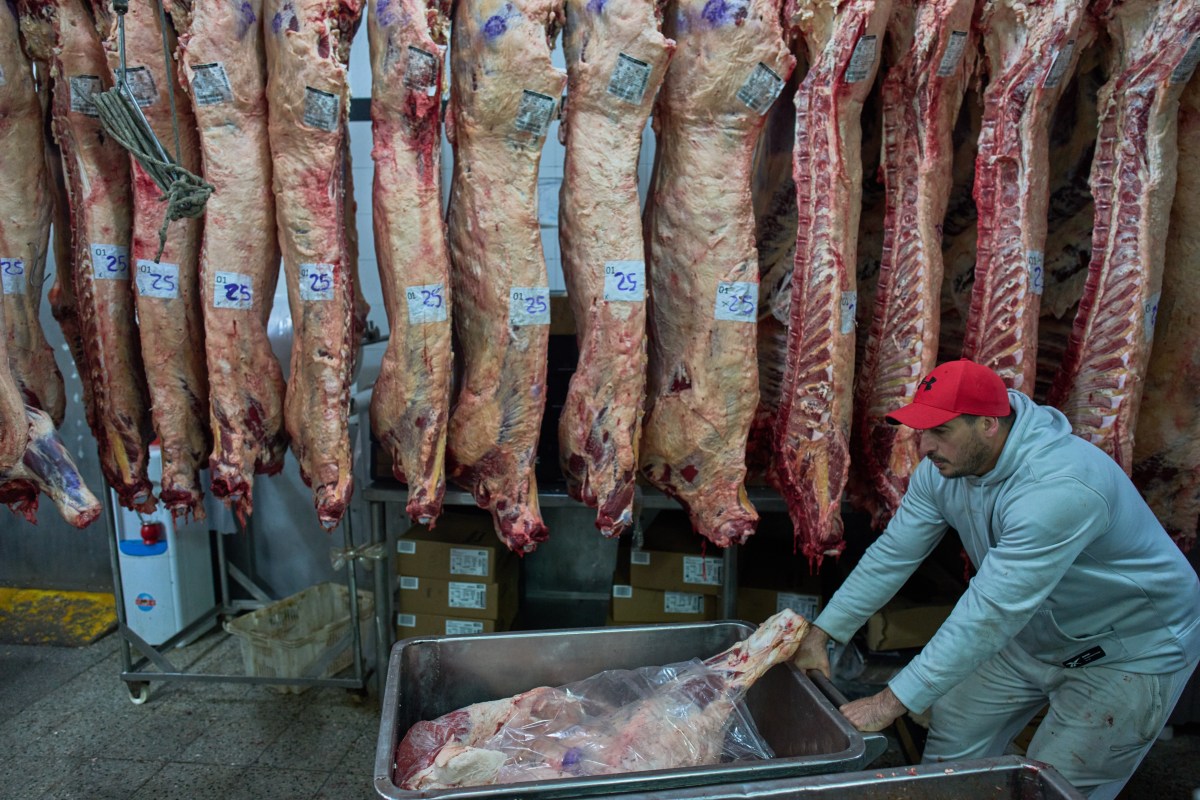
Though questions still surround President Donald Trump’s plan to import foreign beef to ease domestic costs, official announcements from the administration appear to be narrowing the list of countries that could supply the meat to the U.S. On Friday, Trump said he would be removing tariffs on 300,000 metric tons of imported beef, and said that he had secured a “commitment” from an unspecified nation or company that this would be sold at “25 percent below current market prices.” The president followed this up with an official proclamation on Wednesday, in which he said that the deal would help “to ensure that hard-working Americans can afford to feed themselves and their families.” The administration has not confirmed which country or countries would supply the significant quantity outlined in the deal, with some suspecting Argentina could be one of the participating nations. But the language used in official White House communications, and conversations with industry experts in the U.S. exporting countries, appear to exclude Argentina, as well as several other prospective suppliers with whom the U.S. has existing tariff or free trade agreements.
The White House pointed Newsweek to its fact sheet on the deal, and spokeswoman Anna Kelly said that Trump was “delivering on his promise to consumers by reducing beef prices while allowing our domestic beef herd to grow.” “I am not privy to talk about that,” Agriculture Secretary Brooke Rollins told reporters on Tuesday, when asked about the origins of the 300,000 metric tons of lean beef trimmings that are supposedly on their way to the U.S. The president also refused to say which countries would participate in the plan. However, according to a fact sheet released by the White House alongside Trump’s proclamation, the deal increases the amount of beef eligible for lower tariff rates, but “does not modify any commitments related to beef for countries with a free trade agreement with the United States, and does not apply to countries with country-specific beef quotas.” Countries which fall under this definition include some of America’s main importers, like Argentina, as well as Canada and Mexico, courtesy of the USMCA free trade agreement.
The Canadian Cattle Association, an analogous advocacy group, likewise told Newsweek that “Canada and Mexico are not subject to beef import restrictions in the USA so there are no changes for either of our countries.” Australia would appear to be twice excluded, given its country-specific beef quota alongside its free trade agreement with the U.S. The countries seemingly excluded from the plan include many of America’s largest sources of imported beef, though Brazil, its leading foreign supplier, appears eligible. Herrera told Newsweek that the terms of the deal mean “it is taken for granted that nearly all of the supply should come from Brazil,” which he described as “the country with the greatest potential to take advantage of this quota, as they have both the volume and fluid commercial contacts in the U.S.” “Perhaps Paraguay can also participate, but on a smaller scale,” he added.
Colin Carter, a professor emeritus of agricultural and resource economics at the University of California, Davis, likewise pointed to Brazil as the most obvious option, and said that Nicaragua could supply some of the 300,000 metric tons. Anderson told Newsweek that Brazil may also be able to meet this order, given the strict tariff-rate quota (TRQ) system China has imposed on its beef imports for 2026. But this has done little to reduce the confusion that still surrounds this and other elements of the plan, set to take effect from September 1.
"The idea that someone will sell the beef at a 25 percent discount “raises more questions than it answers,” Charlebois told Newsweek, adding that unless the government is subsidizing the distributor, "it is difficult to see how this would work commercially." "The administration should identify the intermediary and explain who is absorbing the difference,” he said. It could cause some real volatility in wholesale markets if this really comes in.” Contact Newsweek editors on this story: Daniel Orton and Sam Wilson.
Extract — continue reading at the source.