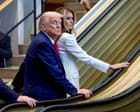
The annual gathering of the United Nations general assembly has historically been a platform for US presidents to display their most serious face and a positive vision to the world. From Harry Truman and Dwight Eisenhower to John F Kennedy and Barack Obama, over eight decades US leaders have used the setting to expound on grand themes before a global audience at pivotal moments in international affairs. As world leaders and officials gather in New York for the yearly event, and Donald Trump prepares to address them on Tuesday, how he will contribute to this historic catalog of remarks is a matter of speculation.
The US president has spent recent days blitzing social media on a variety of topics, from his planned triumphal arch in Washington to a bid to rebrand artificial intelligence, as he contends with an unpopular war and low approval ratings that threaten to drag down his party in November’s US midterm elections. His previous addresses to the assembly suggest that the chances of a non-divisive and uplifting message are low. Last year, Trump shocked the august gathering in his first appearance since returning to the White House the previous January by declaring to those present that their countries were “going to hell” while launching a full-frontal assault on the UN and the concept of open borders.
In 2018, during his first presidency, Trump drew laughter from fellow leaders when he opened his address by claiming: “In less than two years, my administration has accomplished almost more than any other administration in the history of our country.” The previous year, he had attacked longstanding allies, singling out Germany for its energy policy, and declaring that the US “can no longer be taken advantage of, or enter into a one-sided deal where the United States gets nothing in return”. This time around, Trump’s recent social media activities hinted at an even more volatile than usual state of mind from a leader who can be erratic at the best of times. Arguably the most eye-catching was his declaration in an early Sunday morning post that he intended to turn his highly controversial planned arch in Washington DC into a military storage facility, claiming – without providing evidence – that the move was requested by the US military.
A post headlined “His Hemisphere” and depicting Trump gazing at a map of the globe ominously hinted at an imperious tone he could strike, less than nine months after US forces seized the former Venezuelan leader, Nicolás Maduro, in his compound in Caracas and spirited him and his wife to New York. The Trump administration has since trumpeted a deal giving it control over a significant segment of Venezuelan oil reserves. In another post, Trump postures as the defender of AI – denouncing recent fears that its rapid development could presage the destruction of the human race.
Instead, he painted it as the latest target of “many hoaxes, all generated by the radical left dumocrats, for purposes of destroying our country” and announced his plans for an “AI force”– headed by an “AI Czar” – in the image of the space force, established during his first presidency. In an echo of his 2018 speech, on Friday he posted a list of his “Top 25 Trump Achievements” since returning to office. Trump’s appearance before the general assembly will be his first before his fateful decision to launch, in tandem with Israel, a war against Iran in February.
The conflict – despite his predictions that it would last a few days, and result in the collapse of Tehran’s Islamic regime – shows no signs of ending. Iran’s closure of the strait of Hormuz, a strategic waterway that was a conduit to one-fifth of the world’s oil exports before hostilities began, has sent global energy prices soaring and stoked inflation in the US, challenging the prospects of Trump’s Republican party in November’s midterms. Polls show a majority of Americans oppose the war, which has further deflated his approval ratings.
Extract — continue reading at the source.