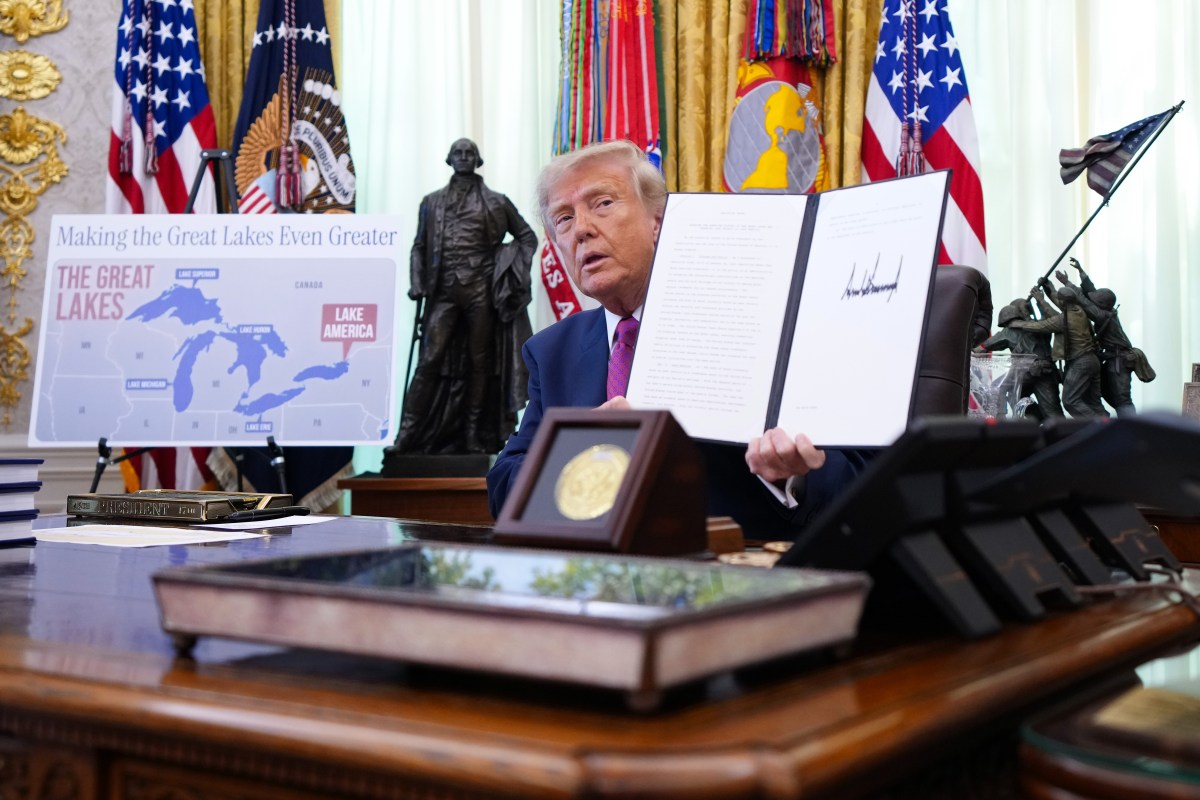
Donald Trump is pushing forward plans to rename Lake Ontario as "Lake America," but past accounting on the president’s sweeping federal rebrand indicates that this could prove a costly effort for the American taxpayers to bear. Following a breakdown in trade negotiations between the U.S. and Canada in August, Trump said that the U.S. was giving "serious consideration" to the change, given "we don’t expect to be doing much business with Ontario any longer." The president formalized this in an executive order on August 27, which directed Interior Secretary Doug Burgum to "take all appropriate actions" to "ensure all federal government references to Lake Ontario, including on executive department and agency maps, contracts, and other documents and communications, shall reflect its renaming." "We’re on it, Mr. The places and waters that border our nation and support our economy should reflect the greatness of the United States," Burgum posted to X following the order.
The Geographic Names Information System (GNIS) has been officially updated to "Lake America," and the website currently states that its mapping software is "in the process of being updated." Companies including Google and Apple have also followed suit, though not every provider has complied. Beyond the costs associated with updating software and physical signage, however, experts say numerous other expenses are likely to arise as public and private players attempt to implement only one of the latest name alterations that have been floated by Trump. Newsweek has contacted the Department of the Interior for comment via email and is awaiting a response.
The August 27 order includes guidance for the relevant agencies on updating the federal geographic location databases and ensuring that all mentions of "Lake Ontario" are expunged from government websites. But replacing geographic nomenclature across all civilian agencies such as the U.S. Geological Survey, the Federal Aviation Administration (FAA) would place a major administrative cost on the departments, which are made to comply with the order.
Linda Bilmes, a senior lecturer in public policy at the Harvard Kennedy School and former chief financial officer for the Department of Commerce, told Newsweek that such changes are "not as straightforward as one might imagine." Bilmes said the matter arose during her time on the National Park Service Advisory Board, and that this resulted in "numerous administrative costs." Robert Corradino, mayor of Oswego, a city in New York, told Newsweek last week that "even a conservative estimate suggests that updating signage, maps, tourism materials, and other public references would cost several thousand dollars." He added that, for a small city of only 17,000, such an expense "represents a significant and unnecessary financial burden at a time when we are focused on maintaining essential services and keeping taxes stable." Corradino, a Republican, released a statement last week in which he said that the city’s government does not back Trump’s executive order and sees no reason to alter the lake’s current name. Beyond the man hours involved in updating the GNIS and other websites, Bilmes noted the need to change printed materials like maps and brochures, as well as the "physical labor hours involved in changing all the road signage, park signage, plaques, trail maps, trail markers, etc." Philip G. Joyce, a professor of public policy at Maryland University and former Congressional Budget Office (CBO) analyst, said that reaching a precise estimate for this aggregate expense "would be difficult or impossible," though he noted that there will likely be "a ripple effect to these things which could create costs for any organization that must adapt to the change." A useful comparison comes from the CBO concerning the "Gulf of America" change, adopted on the first day of Trump’s second term.
In analysis of a bill aimed at codifying the January 20 executive order, the nonpartisan agency said that it would cost up to $500,000 over five years to update all necessary federal documents and maps. During debates in May, however, Democrats on the House Rules Committee noted that there would also be major associated outlays for the nation’s schools and municipal services. At the state level, New York, the only state with a shoreline on Lake Ontario, has no plans to implement any changes following Trump’s order.
Dorf, a professor of law at Cornell, writes that the change could still burden the Empire State, as it will be forced "to take expensive steps in coordinating state and federal programs, training personnel, and alerting the public to the fact that ‘Lake America’ and ‘Lake Ontario’ refer to the same body of water." And, beyond replacing signage, Mike Shriberg, director of the University of Michigan’s Water Center, offered an analysis for the environmental website Circle of Blue, in which he estimated that the change would disrupt decades of environmental data sets and scientific collaboration, while costing agencies and researchers millions of dollars. "The important question, it seems to me, is whether there is any substantive benefit to a given name change," said Joyce. He told Newsweek that any rebrand which fails to lower costs, improve government performance or offer citizens any "substantive benefit" would "represent the very definition of waste." Following his inauguration last January, the executive branch began renaming a number of departments and geographical landmarks as part of its wider strategy to "honor American greatness." The change from Gulf of Mexico to "Gulf of America" fell within this project, as did switching Department of Defense to "Department of War." The latter, according to CBO estimates, could end up costing between $10 million for a "modest implementation" and $125 million if enacted "broadly and rapidly throughout the department." Were Congress to make the change statutory through
Extract — continue reading at the source.