President Donald Trump's push to use tariffs to raise federal revenue and help tackle the national debt collided with a stark fiscal reality Friday: The United States ended the 2026 fiscal year with a budget deficit of nearly $2 trillion. The $1.992 trillion shortfall was about 12 percent higher than the $1.775 trillion deficit recorded in fiscal 2025, according to figures released Friday by the Treasury Department. It was the third-highest annual deficit in U.S. history, trailing only the pandemic-era deficits of 2020 and 2021.
The Treasury calculated the deficit at an estimated 6.2 percent of gross domestic product, compared with 5.8 percent in fiscal 2025. Federal receipts rose 3 percent to a record $5.40 trillion, but spending increased 6 percent to a record $7.40 trillion. Mark Williams, finance professor at Boston University, told Newsweek that the 12 percent annual increase in the deficit was "staggering." "Such government spending without making needed cuts is not sustainable," Williams said.
"If current spending trajectories hold, the total annual deficit could reach $3 trillion by 2032." The figures come as Trump has argued that tariffs can generate revenue and help reduce the country's debt. But the Supreme Court's February ruling striking down many of his tariffs forced the government to refund billions of dollars in duties collected under them. Roughly $145 billion in tariff refunds were issued during the fiscal year, contributing to an 11 percent decline in net tariff income to about $173 billion, according to Treasury figures reported by .
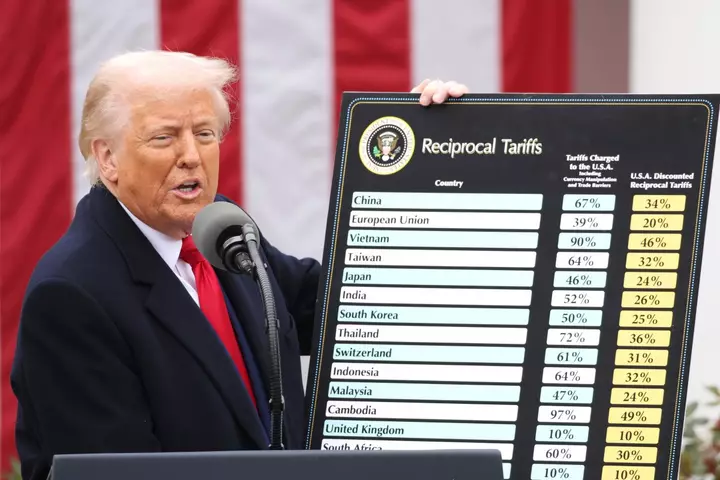
Trump has repeatedly promoted tariffs as both a tool for reshaping U.S. trade and a potentially substantial source of revenue. But changes in the administration's tariff policies following the Supreme Court ruling have significantly altered their fiscal impact. The Congressional Budget Office (CBO) projected in August that changes in trade policy through July 31 would increase cumulative deficits by $900 billion from 2027 through 2036 compared with its February baseline, largely because of the removal of the tariffs invalidated by the court.
The administration imposed replacement tariffs using other authorities, but CBO projected those would raise less revenue. It estimated net customs revenue for fiscal 2026 would be roughly $250 billion lower than it had projected in February. Williams said tariff revenue remained far too small to counter the broader increase in deficit spending.
"Net tariff collections for 2026 are well under $200 billion, failing to offset the substantial growth in federal deficit spending," he told Newsweek. "Aggressive White House trade policies also act as a drag on U.S. economic growth, compounding the challenge of managing and counteracting mounting fiscal deficits." Tariffs nevertheless remain considerably higher than before Trump's second term. The Penn Wharton Budget Model calculated that the average effective U.S. tariff rate was 7.1 percent in August 2026, compared with 2.3 percent in January 2025.
Extract — continue reading at the source.