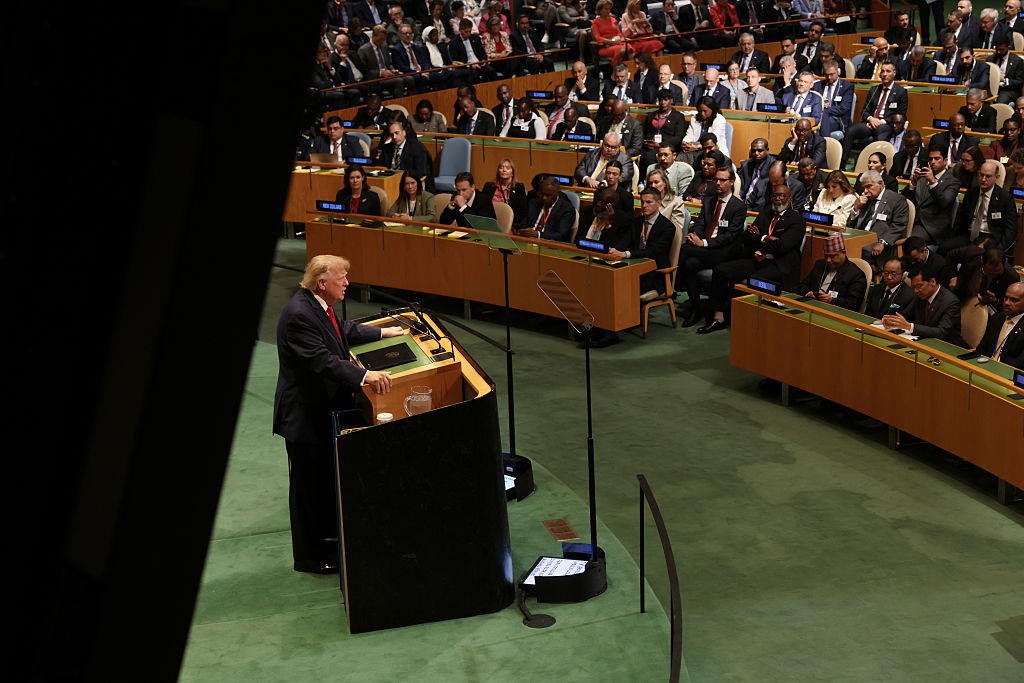
In his speech to the United Nations General Assembly on Tuesday, President Donald Trump spun a familiar web of rhetoric regarding U.S. foreign policy—one that highlights force as a method of achieving peace. In a speech that moved from Iran to Venezuela, Cuba, and beyond, Trump presented something approaching a foreign-policy doctrine: American military might is not the alternative to diplomacy but the leverage that makes it possible. Read More: Iran War Has Cost U.S.
Nearly $40 Billion and Fueled Inflation, CBO Finds David Satterfield, Director of Rice University's Baker Institute for Public Policy, tells TIME that the speech Tuesday demonstrates a position held by the Trump Administration that “force is the only currency of value.” “The strong do as they will and the weak suffer as they must,” he says, further characterizing the approach. In Trump’s telling, strength is not merely a deterrent. It is something to be used—through military action and economic isolation—to force negotiations or impose an outcome.
Trump has repeatedly distilled his foreign policy strategy into three words: “peace through strength.” The examples he gave of this policy in action illustrate how he may see the U.S. functioning as a global enforcer going forward. His definition of the phrase has previously been suggested by its use in Department of Defense ads and in his online endorsements of fellow Republicans. He recently credited this approach for the joint U.S.-Israel strikes that initiated the current conflict with Iran, posting to Truth Social in March: “PEACE THROUGH STRENGTH TO PUT IT MILDLY!!!” Trump’s approach also encompasses economic coercion.
In the case of Iran, he said the U.S. had initially offered economic cooperation, turned to military action when Tehran refused, and was now seeking its “complete economic isolation” to push it back toward negotiations. Trump grouped Cuba among those affected by U.S. economic pressure campaigns on Tuesday. He described a government under mounting strain and predicted political change, declaring that Cuba was a “failed” nation but that “freedom will be coming.” Cuban delegates departed in protest.
Yet Trump presented such coercion as compatible with his role as a global peacemaker. He claimed credit for resolving eight wars since returning to office, although that claim has been widely disputed. In tandem, these elements suggest that Trump sees taking action as a superior means of enacting change.
He proposes the approaches as being almost diametrically opposed: While others only speak of making a difference, he acts. While others have ignored threats, I have confronted them,” Trump said in front of the General Assembly. But it clarified how the President is applying his longstanding ideas today: using military action and economic coercion not merely to deter adversaries, but to force negotiations and shape political outcomes.
Extract — continue reading at the source.