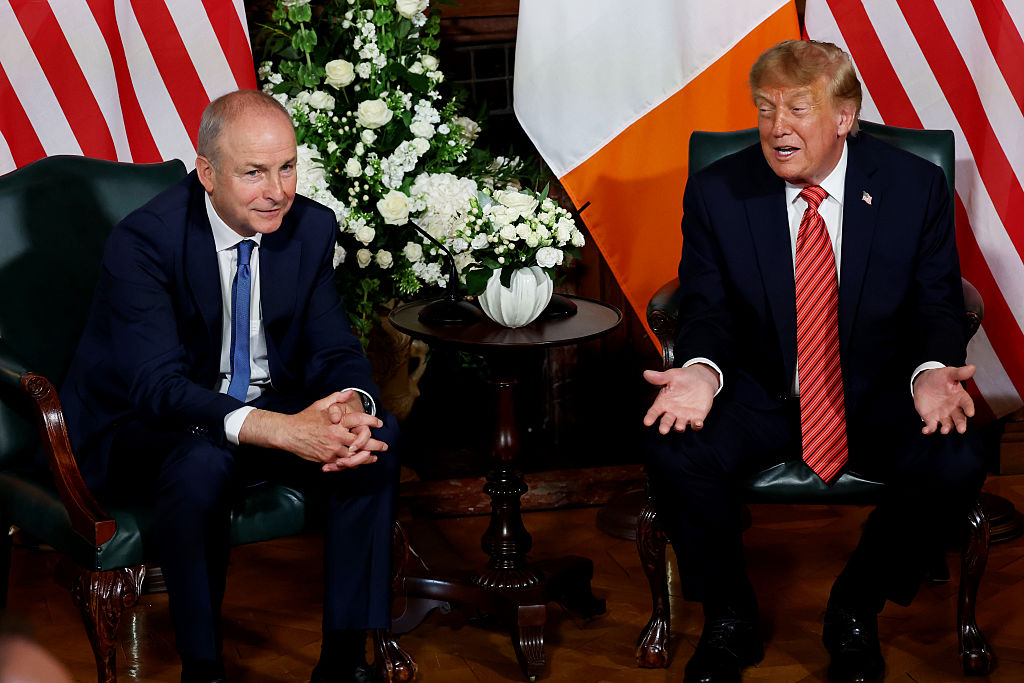
Presidents on the delicate issue of Northern Ireland’s nationhood, Donald Trump on Saturday during his visit to Ireland said that he would “love to see” a united Ireland and that he believed it’s “going to happen eventually.” “You have Northern Ireland, and you have Ireland,” Trump doubled down to reporters on Sunday while visiting a golf tournament at one of his resorts in the Irish village of Doonbeg. President seemed aware that his recent remarks would garner backlash, particularly from the British. Prime Minister Andy Burnham said there was not enough public support for a referendum on Northern Ireland’s future.
Other British politicians have balked at Trump’s statements, arguing that Northern Ireland is indisputably part of the U.K. Martin also downplayed the U.S. leader’s remarks. The Trump family also owns a golf resort in Scotland, which voted against independence from the rest of Great Britain in 2014.
While a northern region of six counties remained part of the U.K., the rest of the island, comprising 26 counties, became the Irish Free State, which eventually became a sovereign republic in 1949. From the 1960s, tensions in the north between largely Catholic Irish nationalists, or republicans, who wish to reunite with the Republic of Ireland, and mainly Protestant unionists who want to stay with Britain culminated in a three-decade, violent period known as the Troubles. A 1998 peace agreement—dubbed the Good Friday Agreement and mediated in large part by the U.S.—ended the violence and recognized the right of those in Northern Ireland to recognize themselves as British, Irish, or both.
It also recognized that Northern Ireland’s status must be based on democratic consent. Following the agreement, Northern Ireland has not yet held a referendum. But Irish nationalism gained momentum when Sinn Féin, the predominant Irish republican party, won the most seats in the Northern Ireland Assembly in 2022.
It was the first time a republican party dominated the assembly since Northern Ireland’s formation, though Sinn Féin must still share power with unionists under local laws. Polls, however, show that the Northern Irish public is still divided on whether it should leave the U.K., and Sinn Féin in Northern Ireland has focused on socioeconomic issues over reunification in recent years. In the Republic of Ireland, Sinn Féin is the largest single party, but it belongs to the opposition after two more moderate center-right parties formed the government following the 2024 election, with Martin as the current leader.
Some have criticized the Irish government under Martin for its slow uptake of the unification issue. Ireland’s Sinn Féin president Mary Lou McDonald said after Trump’s comments: “The conversation on Irish unity has shifted, and the onus is on the Taoiseach to begin planning.” Claire Hanna, who leads the small nationalist Social Democratic and Labour Party in Northern Ireland, also welcomed Trump’s support. The 1998 Good Friday Agreement stipulates that the U.K.’s Northern Ireland secretary can decide to hold a poll and must call one if they believe a majority would vote for Irish reunification.
Extract — continue reading at the source.