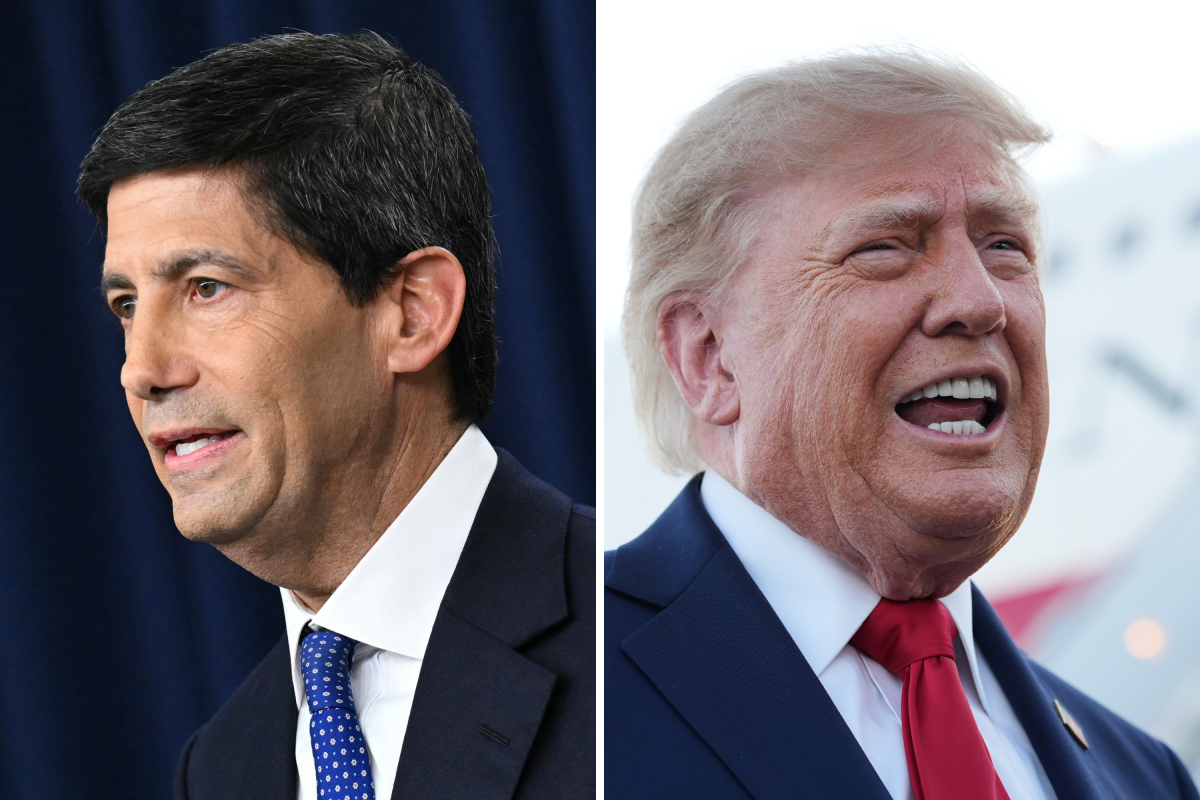
President Donald Trump has called for Federal Reserve policymakers to slash interest rates, once again arguing that elevated borrowing costs are holding his economy back from a boom. On Wednesday, the 12-member Federal Open Market Committee (FOMC) unanimously voted to raise interest rates amid "elevated" inflation and uncertainty, with the central bank’s new Chair Kevin Warsh presiding over the first hike since 2023. Many experts saw the bump as sensible given the evolving inflation picture, and said it helped dispel concerns about an erosion of Fed independence under the leadership of Trump’s hand-picked chief.
But the president himself called the increase "unfortunate" and said rates "should be 1 percent, or less, because we are the Best Credit in the World - BY FAR." However, economists—and comparable cases of premature easing in other countries—point to significant economic repercussions if the central bank bowed to these demands. When approached for comment, the White House referred Newsweek to Trump’s press gaggle in Charlotte, North Carolina, on Wednesday, during which he said interest rates were "too high" and "not appropriate." The president added that most of the FOMC are "very hostile," and said he had told Warsh to "vote with the board because it's not going to matter." The FOMC raised the federal funds rate to 3.75-4.00 percent from 3.50-3.75 percent, a 25 basis point bump designed to ease inflationary pressures, and which will feed into borrowing costs nationwide. While economists largely agree the overall consequences could prove dire, they acknowledge that certain parts of the economy could benefit if the Fed changed course and slashed interest rates to 1 percent—though those benefits would likely be temporary and dwarfed by the broader impacts.
Vicky Pryce, chief economic adviser at the Centre for Economics and Business Research (CEBR) in London, told Newsweek that lowering rates as Trump hopes would "in theory" provide a boost for equities and sectors like retail and travel. Douglas Holtz-Eakin, president of the center-right American Action Forum think tank, said that a "modest decline" would ease the rates paid on mortgages, car loans and other forms of credit, which would in turn "encourage more household and business borrowing and spending, which would translate into more employment growth, but also higher inflation." The significant cuts Trump has called for, however, would result in more severe—and harder to predict—effects. Interest rates were held near zero during the COVID pandemic as the Fed tried to boost spending and business activity and stop the economy from slipping into a deeper recession, but experts believe applying the same logic in 2026 would fail to provide the economic lift Trump envisions.
"The impact would be disastrous," Jonathan Portes, a professor of Economics and Public Policy at King's College, London, told Newsweek. "Partly because it would be highly inflationary to have interest rates at 1 percent when inflation is over 3 percent and unemployment relatively low." Though the process is not automatic, lower interest rates have historically created conditions that exacerbate inflation, as they increase borrowing, spending and overall demand even when the economy produces the same amount of goods and services. South African economist Desmond Lachman, a former deputy director at the International Monetary Fund (IMF), told Newsweek that Trump’s suggestion would be "economically insane." Beyond the direct inflationary impacts, Lachman said slashing rates this way would "signal to markets that the U.S. was on the path to higher inflation," which could trigger a sell-off in American Treasuries and "precipitate the mother of all U.S. government bond market crises." "The last thing that he needs is for bondholders to dump their Treasuries which among other things would send mortgage rates and other borrowing rates through the roof," he added.
"Dropping the rate to 1 percent would most likely produce panic in the bond market, with investor afraid of a sharp rise in inflation," Holtz-Eakin likewise told Newsweek. "Dumping of bonds would actually raise interest rates, with the likely result being a sharp recession." As some economists noted when Trump was contemplating who to nominate as a replacement for Jerome Powell, lowering rates prematurely at a premier’s wishes had in the past inaugurated profound and lingering economic crises. One of the clearest modern examples of this is Turkey.
Over several years beginning with its transition to an executive presidency in 2018, President Recep Tayyip Erdogan, who once called interest rates "the mother and father of all evil," pressured Turkey’s central bank to slash rates despite accelerating inflation. Erdogan fired several central bank governors who tried to tighten monetary policy and installed a loyalist in 2021 to carry out his monetary agenda. This was followed by runaway prices, with Turkey’s annual inflation rate rising to over 80 percent for several months in 2022 and never fully dropping.
Extract — continue reading at the source.