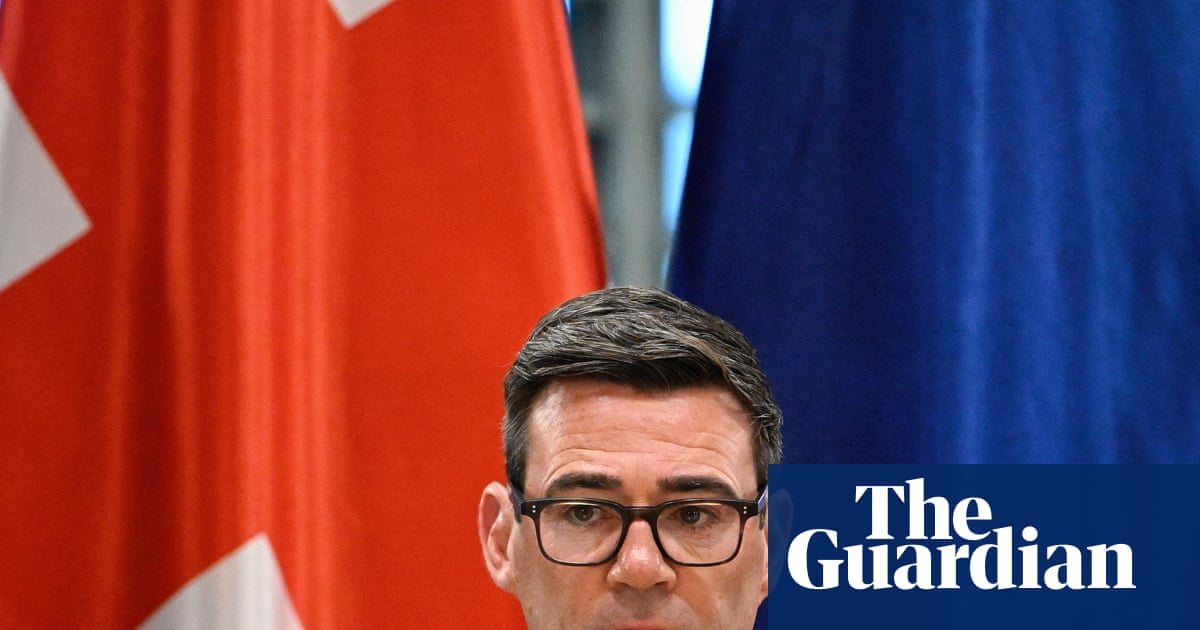
After a holiday spent contracting nursery bugs from an 11-month-old, it’s good to return. Yesterday, Andy Burnham marked his first day back after party conference by calling for a closer relationship with the EU and drawing a line under a decade of “drift and division”. On Sunday, he said it was “clear” the Kremlin had been involved with the 2016 Brexit referendum vote.
Both statements mark a break, rhetorically at least, from his predecessors. Conservative governments long insisted there was no evidence of Russian interference in the Brexit vote. Keir Starmer attempted to put the entire issue of Brexit behind him, treating it as a historic event rather than a cause of economic pain.
But for all his words about a closer relationship with the EU, Burnham has kept the details pretty vague. Today’s newsletter, with the help of the Guardian’s Brussels correspondent Jennifer Rankin and our senior political correspondent Peter Walker, asks what his stance might actually amount to. That’s after the headlines.
UK | Andy Burnham said Iran’s Islamic Revolutionary Guards Corps were “almost certainly” behind threats to RAF Fairford, the firmest attribution of responsibility made so far by the UK after an incident late last month. UK politics | A close adviser to Nigel Farage had an influential role at a national polling company despite not being publicly associated with the firm, the Guardian revealed. Ukraine | Volodymyr Zelenskyy has vowed to respond to Russia’s continuing attacks on the Ukrainian power grid as European leaders rally around Kyiv amid a feud with Donald Trump over Ukraine’s strikes on oil refineries.
Israel | Benjamin Netanyahu has ordered the country’s attorney general and the head of the Shin Bet security service to reveal the identities of soldiers and officers interviewed in the documentary NAZA and prosecute them for causing “harm to Israel’s diplomatic and security interests”. US news | RJ Mitte, the young actor best known for playing Walter White Jr in the award-winning TV series Breaking Bad, died on Monday. In the years after it voted to leave the European Union, Britain became something of a laughing stock among EU member states.
People in Brussels would be staying up to watch votes in the House of Commons,” Jennifer Rankin, who moved to Brussels to cover the EU for the Guardian in January 2016, tells me. Civil servants in Brussels grew to regard the UK as one might regard a belligerent and ungrateful elderly relative, an impression that reached its apotheosis when the former Northern Ireland secretary Brandon Lewis admitted that the UK’s Brexit arrangements for Northern Ireland would break international law (albeit in a “very specific and limited way”.) “From 2016 to 2020, the UK was seen as a model of how not to run your country,” Jennifer says. This impression softened after the passing of the Withdrawal Agreement Act in early 2020, and the Windsor framework deal, which amended the arrangements under the Northern Ireland protocol in 2023.
Extract — continue reading at the source.