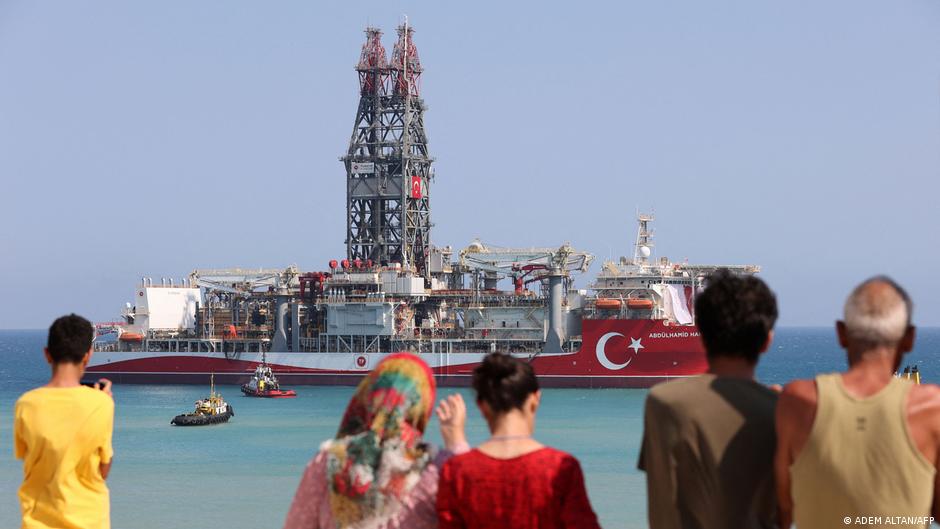
On Tuesday, the parliament of Libya unanimously approved a maritime agreement with Turkey to establish a direct maritime economic corridor between the countries. Turkey had agreed on the corridor with the UN-recognized Government of National Accord in western Libya in 2019. However, the agreement faced opposition from the rival Libyan government in the country's east.
Now, though, the eastern parliament has reversed its previous opposition. The decision, which was welcomed by Turkey's Foreign Ministry, is likely to contribute to tensions with other countries in the eastern Mediterranean — especially Greece . The agreement establishes a direct maritime corridor between the southern coast of Turkey and the northern coast of Libya.
Large oil and gas deposits have recently been discovered in the region in question — estimates suggest that natural gas reserves worth several hundred billion US dollars may lie beneath the seabed. Turkey and Libya aim to secure their economic rights to these raw materials and are seeking to jointly exploit the resources. The planned corridor disregards Greek islands such as Crete, Karpathos and Rhodes.
Greece's government insists that it possesses a comprehensive exclusive economic zone, or EEZ, around these islands and has already announced its opposition to the accord. In a post on X, the Foreign Ministry announced that Greece firmly rejects the agreement and has the support of the European Union in doing so. "The European Union has described the Turkish-Libyan memorandum as null and void, stressing that it violates the sovereign rights of third states and is not consistent with the Law of the Sea," the ministry posted.
Similar wording came straight from Brussels. "I raised yesterday's Libyan vote on a maritime MoU with Türkiye and stressed that it infringes upon the sovereign rights of third states," Kaja Kallas, the European Union high representative for foreign affairs and security policy, posted on X. Whose claims are legitimate in the eastern Mediterranean is the central point of contention.
Greece primarily cites the UN Convention on the Law of the Sea, or UNCLOS. According to Article 121 of the convention, inhabited islands that "support an economic life of their own” have the same rights to an EEZ as the mainland. This applies to Crete, Rhodes and Lesbos.
Extract — continue reading at the source.