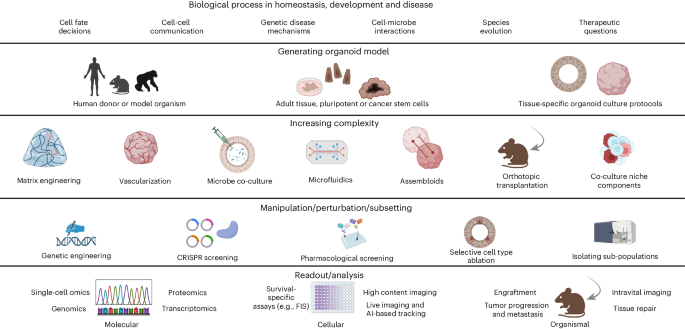
Organoids provide a versatile platform for studying fundamental biology, complementing traditional cell culture and in vivo models. Their unique features, such as self-organization and the possibility for their precise manipulation, have enabled key discoveries in tissue homeostasis, development and disease. This tutorial presents an overview of organoid technologies and protocols across a broad spectrum of applications, from investigating cell fate decisions and cell–cell or cell–microbe interactions to the study of genetic diseases, species evolution and translational/clinical questions.
By focusing on adult stem cell–derived intestinal and human pluripotent stem cell–derived brain organoids, we highlight models with distinct characteristics that together reflect the broader spectrum of organoid systems, tissue types and research contexts. For applications not supported by these models, we discuss organoids derived from other tissues. We also outline current challenges in the field and highlight emerging innovations that are promising to shape future directions.
This is a preview of subscription content, access via your institution Access Nature and 54 other Nature Portfolio journals Get Nature+, our best-value online-access subscription Receive 12 print issues and online access Prices may be subject to local taxes which are calculated during checkout Marsee, A. et al. Building consensus on definition and nomenclature of hepatic, pancreatic, and biliary organoids. Cell Stem Cell 28, 816–832 (2021).
CAS PubMed PubMed Central Google Scholar Wilson, H. A new method by which sponges may be artificially reared. Science 25, 912–915 (1907).
Gewebsaffinität, ein Mittel der embryonalen Formbildung. http://repositorio.fciencias.unam.mx:8080/xmlui/handle/11154/171815 (1939). A study of the mechanics of gastrulation. Zool. 95, 171–212 (1944).
Reconstitution of complete organs from single-cell suspensions of chick embryos in advanced stages of differentiation. USA 46, 1177–1185 (1960). An in vitro and in vivo study of differentiation in teratocarcinomas.
Extract — continue reading at the source.


