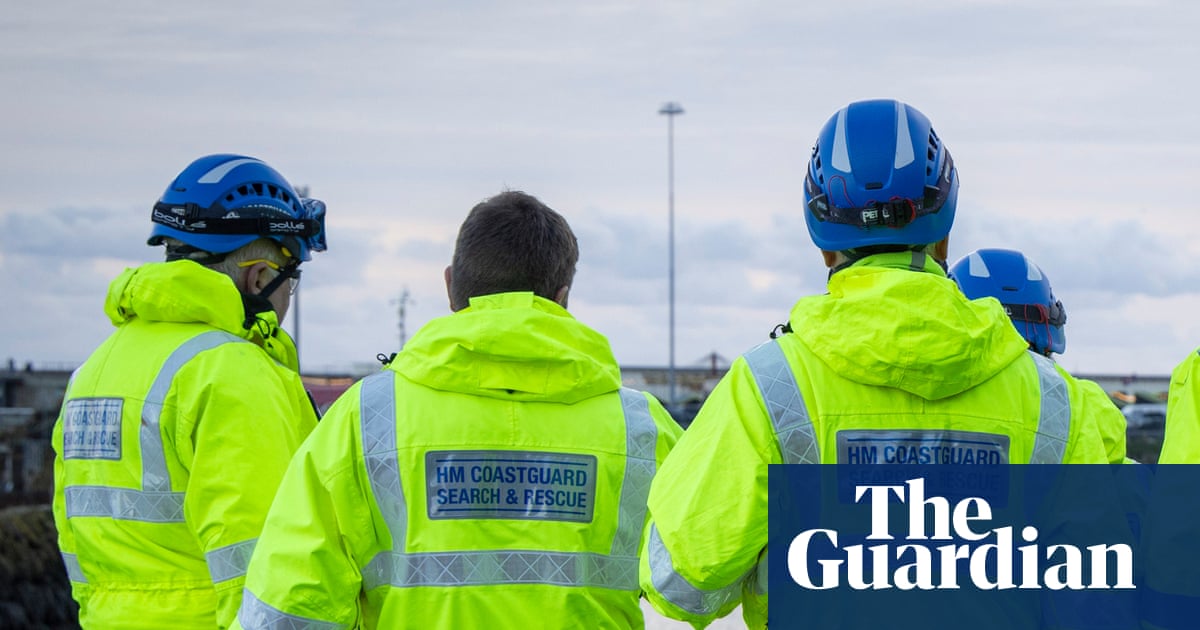
The head of the UK coastguard agency is facing calls to resign after she was found to have used unverified data to back up her controversial plan to strip rescue officers of their pay. Virginia McVea, the chief executive of the Maritime and Coastguard Agency (MCA), claimed more than 90% of coastguard rescue officers supported the proposal, citing an official survey. Now, after an Office for Statistics Regulation (OSR) investigation, the agency has admitted its poll did not sufficiently back up the claim.
Nicola Savage, a national officer for the GMB union, which represents coastguard rescue officers (CROs), said: “If Ms Mcvea is unable to produce the reports she refers to, we would consider this as a deliberate attempt to mislead. If this is the case, she should resign – as hundreds of coastguards have already asked her to do.” Joe Robertson, one of several MPs who has campaigned on CROs’ behalf, accused McVea of misleading MPs and coastguards during three separate meetings at which he said she cited the figure. He called on her to “do the right thing and apologise for misleading MPs, CROs and the public”, adding: “Please also give a written account of how you came to repeat this false line over and over again and why you still have not published the surveys which you promised to MPs in our meeting on 24 June.” The MCA’s plan to strip coastguards of their pay was a reaction to a major court defeat.
A judge affirmed that, while CROs volunteer for service, they are classed as workers with the right to minimum wage and holiday pay because they are paid for their time, among other factors. Rather than respect this status, the MCA tried to stop remunerating CROs in an attempt to reclassify them as volunteers. This led to heavy criticism from MPs, CROs and coastal communities, with the GMB union saying nearly 600 CROs backed its vote of no confidence in McVea.
Seeking to defend the plan, McVea cited the 90% figure, but MPs told the Guardian in July they felt misled by her. In his letter to McVea this week, the OSR’s director general, Ed Humpherson, told her: “Neither of the surveys [cited] asked CROs directly about their support for the proposed volunteer model, so do not provide evidence relating to the reported claims. [The] MCA has been unable to provide any further evidence to underpin the reported claims.” Leaked results of an MCA survey, revealed by the Guardian in July, showed CROs had actually been asked how volunteer and worker models would affect their availability. The results suggested the MCA had included people who said they would become less able to respond to calls if they were volunteers, as well as those who replied “other”, among those in support of the volunteer model.
The agency said at the time that “survey findings were considered alongside a range of operational, legal and practical factors”. But it refused to say how. The plan was ultimately scrapped by the maritime minister, Keir Mather, as he responded to near-universal criticism.
CROs are still waiting to find out what system will be adopted, but it is understood the option of not paying coastguards is no longer on the table. The MCA has been approached for comment.
Extract — continue reading at the source.


