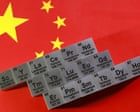
The UK is “dangerously” dependent on China for critical raw materials needed for the military, renewable energy infrastructure and AI, a parliamentary investigation has found. MPs on the business select committee called for an urgent centralised policy and the creation of a “critical minerals finance facility” to help fund rare earth and other critical mineral mines, and deploy grants, equity and debt to accelerate a diversification programme. China has a stranglehold on the world’s supply of rare earths and other critical minerals, as well as their refined byproducts that are used in everything from military jets to car-locking systems and consumer products such as fridges and washing machines.
The committee heard that “the processing stage” was where the bottlenecks were, with China dominating the refining of seven categories of minerals, including refined lithium needed for electric vehicles and rare earths used in the fuselage and wings of military aircraft to help withstand temperature extremes. MPs were told that demand for lithium alone would increase 45-fold between now and 2030, leaving the UK in a high-risk dependency relationship with China. The demand for rare earths needed for permanent magnets used in military jets and other applications would rise 16-fold in the same period as Britain was seeking to rebuild its military capabilities.
But with China capable of suddenly turning off rare earth supplies, as it did in 2025, a dependency on Beijing was a strategic vulnerability for the UK economy and national security, the committee found. Separate restrictions on legacy chips after a row over a Dutch intervention in the China-owned Nexperia left the European car industry “days away” from stoppages last October. The EU, the US and other countries faced the same risk of supplies of rare earths being cut off by China, and the committee said the UK was not putting enough effort into finding alternative supplies.
Donald Trump secured a one-year reprieve on global export restrictions on rare earths from Xi Jinping in October last year. This was extended to January 2027 after the Chinese president’s recent visit to Washington. However, the reprieve means the UK is at the mercy of US-China relations, the report suggests.
The most “realistic” solution was for the UK to work closely with G7 partners, the rest of Europe and Indo-Pacific countries, to “aggregate demand” and bring in new suppliers. The committee said its investigation was frustrated by lack of transparency by the government. The committee has drawn up a 10-point plan that includes: working to identify domestic mining; refining and recycling opportunities and their costs; a strategy to encourage business to reduce procurement from China; a plan to unlock investment; and assess planning and permitting processes that may prove a barrier to mining.
As it stood, the committee said it could not be confident the government could satisfy any of its 10 tests. A government spokesperson denied it did not have a critical minerals strategy saying it was delivering £400m “to ramp up domestic production and recycling” and forge new international partnerships.
Extract — continue reading at the source.