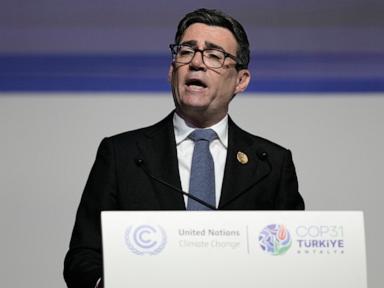
The United Kingdom has appointed a special envoy to address climate change security threats ANTALYA, Turkey -- The United Kingdom on Thursday announced the appointment of a special envoy to tackle security threats from climate change while small island leaders called for urgent action, describing the issue as a life-or-death issue for their people at the climate talks in the Turkish resort town of Antalya. "For Seychelles, climate action is not simply an environmental priority. It is a fundamental issue to our national security, economic stability, sustainable development and our very survival.” Pillay was speaking on the second day of the leaders' summit at the U.N. climate summit, where government leaders addressed the state of a warming world and what to do about it.
While all the globe is threatened by climate change’s souped-up storms, hotter heat waves, worsening droughts and floods, island nations are among the hardest hit as they also have to deal with rising seas swallowing up their land. Pillay said Seychelles is experiencing millions of dollars of damage as a result of storms and floods, made worse by climate change despite contributing few planet-heating gases that increase global warming. He said a U.N. fund created for compensating for climate-related loss and damage needs to be urgently strengthened.
It is a warning of what is coming if we do not cut emissions now," Tagelagi said. The comment came as a report said the world has failed to slow global warming trends in the past five years because plans weren’t realized and efforts that would have helped were canceled out. The first five years after the 2015 Paris Agreement, the world did so much that it trimmed an entire degree Celsius (1.8 degrees Fahrenheit) from warming projections, but nothing has changed since, the report said.
Climate change is caused mainly by the release of greenhouse gases, which happens when fuels like gas, oil and coal are burned. Confronting climate change means finding ways to drastically cut the amount of emissions put into the atmosphere each year. Countries establish plans to reduce emissions, called nationally determined contributions.
The speed of reductions and ways to achieve them are different by country. Because collective efforts of countries haven't significantly reduced global emissions, the world is now “headed toward an irrecoverable overshoot of 1.5 degrees Celsius” (2.7 degrees Fahrenheit) above pre-industrial temperatures, which is the warming threshold the world adopted during the Paris Agreement, according to the report. The report said if the nations of the world fulfill all their climate promises — which is a big if — the globe will end the century 2.6 degrees Celsius (4.7 degrees Fahrenheit) warmer than preindustrial times.
That’s the same pace the globe was on in 2024 and 2025, showing that new promises made last year have “failed to move the needle” of projected warming, said report lead author Sarah Heck, a climate policy analyst at Climate Analytics. It is upon us all now devastating lives and livelihoods everywhere." He said Britain would place climate resilience high on the agenda when it assumes the G20 presidency next year. The appointment of Madeleine Alessandri as special representative for climate security follows a British government assessment earlier this year warning that damage to ecosystems, driven partly by climate change, could disrupt food supplies and fuel conflict and migration since the island-nation imports about 40% of its food.
Extract — continue reading at the source.