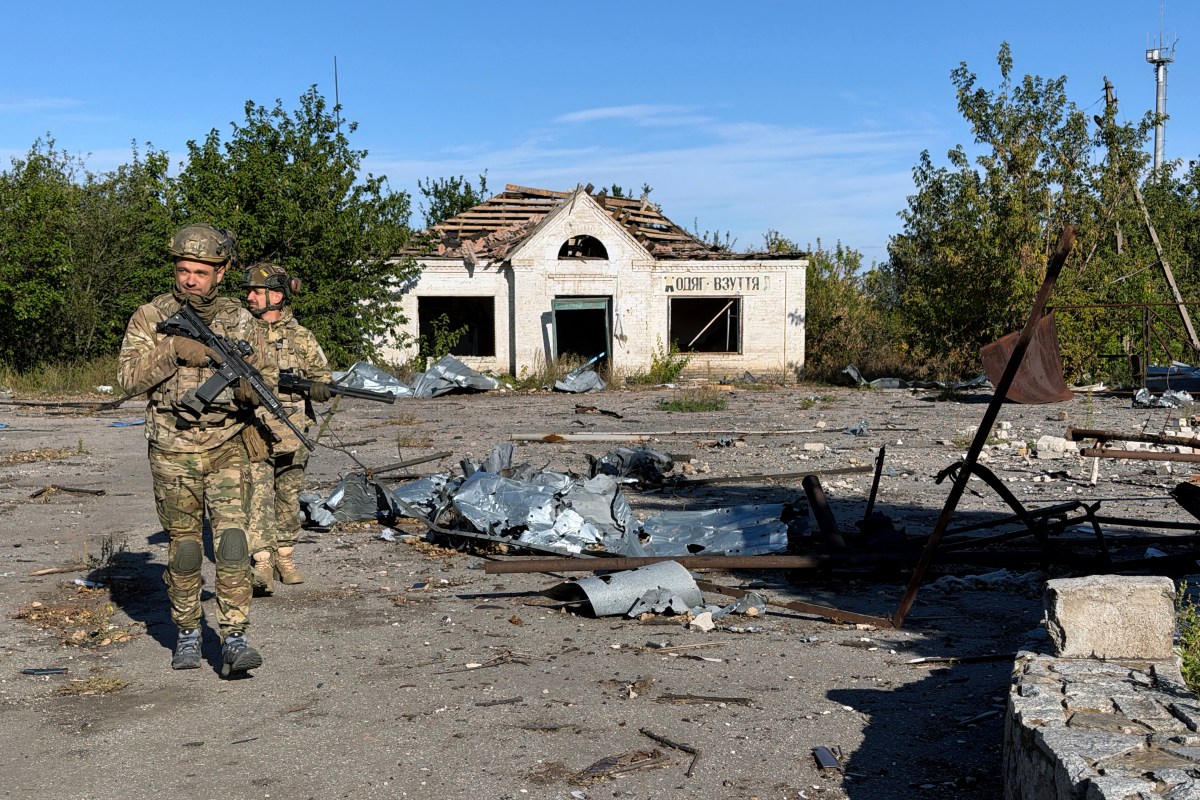
Territorial gains in Kyiv’s counteroffensive in the Donetsk oblast will be followed by a critical few months as the weather turns cold and Vladimir Putin looks likely to step up long-range strikes ahead of the toughest winter of the war. Ukraine’s Third Army Corps touted success with bomber drones and remote-controlled robots during “Operation Vivaldi,” which thwarted Russian attempts to encircle the Fortress Belt critical to defending the Donbas region. However, as Putin faces a battlefield calculus of 46,000 troop losses last month for no territorial gains, according to Kyiv, there are fears he is likely to increase strikes on Ukrainian energy infrastructure to freeze Kyiv into submission.
Germany’s chancellor Friedrich Merz arrived in Kyiv on Sunday, saying that Ukraine was facing "decisive weeks” following days of Russia's bombardment, which included hitting bridges spanning the Dnipro River. Giorgi Revishvili, from the “Russia Analyzed” Substack, told Newsweek that on the battlefield, Ukrainian forces faced a tough autumn and winter during which adverse weather could affect Kyiv’s strike capabilities. Newsweek has contacted the Russian defense ministry for comment.
Ukraine’s president Volodymyr Zelensky said that Kyiv was preparing the fourth phase of Operation Vivaldi, a counteroffensive in the Lyman area of the Donetsk region, which aims to disrupt Russia’s goal of seizing the entire Donbas. The operation has been ongoing throughout the summer, but details have only been revealed in the last couple of weeks. According to The Kyiv Independent, Ukrainian Brigadier-General Andrii Biletskyi said his troops had retaken 68 square miles of territory thanks in part to what Zelensky said was “replacing our soldiers with ground robotic systems whenever possible.” Biletskyi announced a world-first when attack ground robots went into Russia’s rear.
A robotic amphibious platform also moved supplies to Ukrainian troops across 25 miles of mixed land and water. Operation Vivaldi improved Ukraine’s positions north of Lyman, denying Russian forces the opportunity to cut the Kharkiv–Sloviansk and Izium–Sloviansk highways, critical to Ukrainian logistics, Revishvili said. The operation also reduced the threat of an encirclement of the Sloviansk–Kramatorsk agglomeration from the north, he added.
Revishvili explained: “Ukraine has been conducting Operation Vivaldi for months under tight operational security, and only now is revealing the results of the operation. It will be particularly interesting to see how the final phase develops and whether Ukrainian forces are able to consolidate and expand their gains.” Over the last week, Russia has launched a massive, combined drone and missile strike that mostly targeted energy infrastructure in Kyiv and the surrounding region, often using faster jet-powered drones that are difficult for Ukrainian air defenses to intercept. Ukrainian Prime Minister Serhiy Koretskyi said Russia had conducted the largest combined strike package on energy infrastructure since the end of the heating season in April, after a school and Kyiv's Southern Bridge were struck.
The Ukrainian monitoring Telegram channel eRadar said Russian forces will increase strikes on electricity generation and transmission facilities. Meanwhile, Ukrainian economy minister Oleksandr Kravchenko has warned that his country could face the harshest winter of the full-scale invasion that started on February 24, 2022. Russian forces have struck Kyiv’s southern and northern bridges at least six times since October 1, disrupting civilian transportation and logistics across the Dnipro River.
Extract — continue reading at the source.