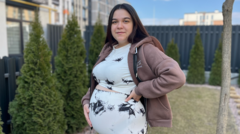
Ukraine war 'led me to surrogacy' to earn money but a new law could end those plans Sofia Bettiza,World Service Global Health Reporter, KyivandBBC News UkrainianBBCKarina Tarasenko says she became a surrogate because of the war and now plans to have as many surrogate babies as possibleKarina is six months pregnant, but the foetus inside her womb is not her own.The 22-year-old from eastern Ukraine is a surrogate, pregnant with an embryo from a Chinese couple's egg and sperm.At the age of 17 Karina's home was destroyed when her city, Bakhmut, became one of the most fiercely contested battlegrounds in the early phase of Russia's full-scale invasion.With most of the city turned to rubble and ash, she and her partner moved to Kyiv but they struggled to find steady work.It was when Karina was in a shop one day, with barely enough money to pay for bread and nappies for their one-and-a-half-year-old daughter, that she decided to turn to paid surrogacy.She says the war "led me to surrogacy" and that without the conflict she would never have considered it. The fighting has led to millions of people losing jobs and businesses, surging inflation and a sharp drop in Ukraine's GDP."At first, becoming a surrogate made me angry and disappointed, but now I've just accepted it," says Karina Tarasenko who now lives on the outskirts of Kyiv in an apartment provided by her surrogacy clinic. She is pregnant with a girl.She will earn £12,500 ($17,000), roughly double the average salary in Ukraine, though she'll get most of the money after she gives birth.Karina had been due to receive £15,500 ($21,000), but when one of the twins she was pregnant with died, her pay was cut, as was stipulated in her contract.Despite her initial misgivings, Karina now plans to have as many surrogate babies as her body will allow to save up to buy a home.But the decision may soon be taken out of her hands.BioTexComActivists have criticised advertising campaigns and accused clinics of turning reproduction into a commodityPrior to the war, Ukraine was widely cited as the world's second commercial surrogacy hub behind the United States.While the conflict significantly impacted surrogacies, they have nearly bounced back to pre-war levels, experts have told the BBC World Service.But Ukraine's parliament is now considering a bill that would introduce stricter oversight of the surrogacy industry and effectively ban access to foreigners, who make up 95% of the intended parents.
The proposals have widespread support across Ukraine's parliament.The bill aims to regulate more tightly an industry that has been accused of turning reproduction into a commodity and exploiting poor, vulnerable women. Supporters of the bill also argue that Ukrainian women should not be having surrogate babies for foreigners at a time when birthrates have plummeted due to the war - though the number of babies born through surrogacy is a small proportion of births."Because of the war the number of women who are desperate is growing, and clinics offer them this opportunity because Western couples want to buy babies cheaply," says Maria Dmytrieva, a women's rights activist who opposes all surrogacy on ethical grounds and argues the proposed law does not go far enough.She believes the practice should be banned entirely in Ukraine.She accuses surrogacy clinics of openly targeting poorer women, pointing to social media advertising.One AI-generated advert in January this year, posted by a clinic to recruit new surrogates, shows a woman forced to decide between buying wood to heat her stove or clothes for her children, appealing to the hardship many Ukrainians have endured during the war.Another advertising campaign in 2021, by Ukraine's largest surrogacy clinic, BioTexCom Centre for Human Reproduction, promotes a "Black Friday sale" on surrogate babies.Challenged by the BBC over whether these adverts could be seen as being offensive, BioTexCom defended them, saying they were effective in bringing attention to surrogacy.The clinic has also come under criticism for the way it operates. In 2018, the prosecutor's office launched an investigation into the clinic's chief executive officer, Albert Tochilovsky, and two other former members of staff, on suspicion of offences including human trafficking.It said that the pre-trial investigation had since been suspended to allow for "international co-operation" and gathering information from abroad.BioTexCom and Tochilovsky say they always act within the law and "categorically deny the allegations".The prosecutor did not give details of the trafficking allegation but BioTexCom told the BBC it involved a DNA mismatch between a set of parents and a baby.
The clinic says its staff were not responsible and that they "think the issue happened during the sperm collection" which took place in another country.The company says it helps people fulfil their dreams of becoming parents, gives women a chance to make money legally and provides them with medical care, accommodation and food.Karina initially approached BioTexCom to be a surrogate but chose not to proceed with the clinic, feeling they had treated her coldly in initial appointments with them.Left-behind childrenWei is being cared for in a state-run home in Ukraine after his intended parents did not collect himThere are also cases of babies being abandoned after birth when biological parents change their minds.In Ukraine, the intended parent is legally responsible for the baby after birth and it is against the law for them to abandon a child for any reason.But in practice, enforcement across borders can be challenging.Wei, who is now five years old, suffered severe brain damage after he was born prematurely in 2021. His surrogacy was arranged through BioTexCom.He now lives in a state-run home for disabled children in Kyiv.When the BBC visited, Wei was having mashed banana with his friends at the home. They sit together for every meal.Wei canno
Extract — continue reading at the source.