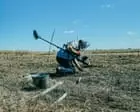
Crouched over on her hands and knees in a field of weeds, Olena Kabanova is digging into the ground. With a shovel and a steady hand, the 58-year-old digs out a neat square around the spot where a mine detector has sensed a suspicious object. Four years ago, this field in eastern Ukraine was occupied by Russian soldiers.
Now back under Ukrainian control, it is littered with landmines. Civilians such as Kabanova are trying to make the land usable again. Landmines are a scourge of conflict zones.
Littered across contested territory, they leave land unusable for years after a war has ended. Removing them is an expensive and dangerous job. And the use of long-range drones in Ukraine, which is often described as the most mine-contaminated country in the world, is increasing the scale of the problem.
Drone and missile attacks make working outdoors unsafe; humanitarian workers are sometimes directly targeted. And newer, deadlier threats are also appearing. They include the POM-3, a small cylindrical mine used by Russian forces that could be mistaken for an abandoned vacuum flask.
It is detonated by the vibrations of approaching footsteps. POM-3 mines mean there are “specific villages that we just completely avoid”, says Anda Riza, a unit commander of the Halo Trust, the largest international humanitarian demining organisation in Ukraine, which employs Kabanova in the field in Kharkiv. The types of landmines are “constantly developing and evolving”, says Valeriia Shumska, Riza’s colleague.
But the technological innovation that is emerging from the conflict is also helping deminers to come up with new ways of working, which they hope are quicker and safer than the traditional hands-and-knees approach. The advances are being supported by the $1.5bn funding that has poured into Ukraine’s demining sector since the start of the full-scale invasion. Digging out a patch of land could take up to 45 minutes.
Extract — continue reading at the source.