Piercingly true as this may be, we’ve known at least since Plato’s famous Allegory of the Cave that “most people are not just comfortable in their ignorance, but hostile to anyone who points it out.”. Although science is driven by “thoroughly conscious ignorance” and the spiritual path paved with admonitions against the illusion of thorough understanding, we cling to our knowledge — our incomplete, imperfect, infinitesimal-in-absolute-terms knowledge — like we cling to life itself. And yet the contour of what we know is a mere silhouette cast by the infinite light of the unknown against the screen of the knowable.
Schumacher captured this strange dynamic in the concept of adaequatio — the notion that “the understanding of the knower must be adequate to the thing to be known.” But how do we face our inadequacy with grace and negotiate wisely this eternal tension between the known, the unknown, the knowable, and the unknowable? That’s what Lebanese-American scholar, statistician, and essayist Nassim Nicholas Taleb explores in a section of his modern classic The Black Swan: The Impact of the Highly Improbable (public library) — an illuminating inquiry into the unknowable and unpredictable outlier-events that precipitate profound change, and our tendency to manufacture facile post-factum explanations for them based on our limited knowledge. Taleb uses legendary Italian writer Umberto Eco’s uncommon relationship with books and reading as a parable of the most fruitful relationship with knowledge: The writer Umberto Eco belongs to that small class of scholars who are encyclopedic, insightful, and nondull.
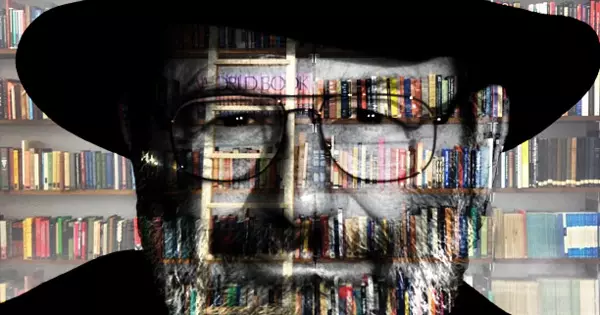
He is the owner of a large personal library (containing thirty thousand books), and separates visitors into two categories: those who react with “Wow! Signore professore dottore Eco, what a library you have! How many of these books have you read?” and the others — a very small minority — who get the point that a private library is not an ego-boosting appendage but a research tool.
Read books are far less valuable than unread ones. The library should contain as much of what you do not know as your financial means, mortgage rates, and the currently tight real-estate market allows you to put there. You will accumulate more knowledge and more books as you grow older, and the growing number of unread books on the shelves will look at you menacingly.
Indeed, the more you know, the larger the rows of unread books. Let us call this collection of unread books an antilibrary. Eco himself has since touched on humanity’s curious relationship with the known and the unknown in his encyclopedia of imaginary lands, the very existence of which is another symptom of our compulsive tendency to fill in the gaps of our understanding with concrete objects of “knowledge,” even if we have to invent them by the force of our imagination.
Taleb adds: We tend to treat our knowledge as personal property to be protected and defended. It is an ornament that allows us to rise in the pecking order. So this tendency to offend Eco’s library sensibility by focusing on the known is a human bias that extends to our mental operations.
Extract — continue reading at the source.