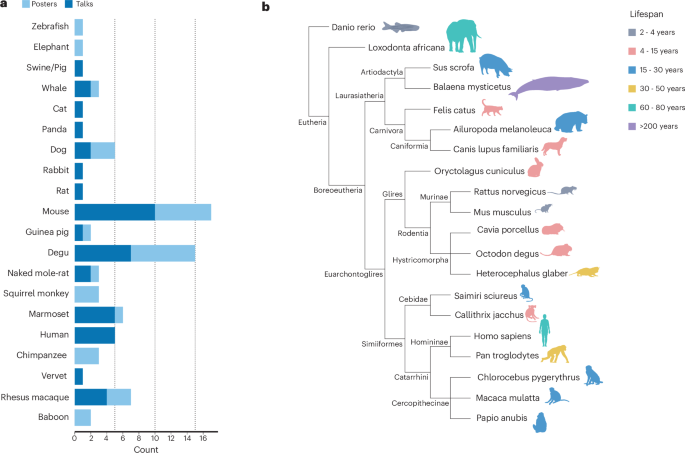
Alzheimer’s disease (AD) remains a major unmet medical challenge, highlighting the need for improved experimental models. The second Unconventional Animal Models of Alzheimer’s Disease and Aging (UAMAA 2026) conference brought together ~150 interdisciplinary researchers to discuss advances across 19 animal models of AD and aging. Six major themes emerged: naturally occurring AD-like pathology, neuroinflammation, population heterogeneity, development of genomic and molecular resources, companion dogs as translational models and the promise of laboratory-amenable species such as the Chilean degu and common marmoset.
These discussions highlighted the growing value of cross-species approaches for advancing translational AD research. Alzheimer’s disease (AD) is the most common form of age-related dementia and accounts for an estimated 60–80% of worldwide dementia cases1. AD is an escalating health and financial crisis, a trend exacerbated by advances in medicine, technology and public health infrastructure that have lengthened the typical human lifespan.
The epidemiological consequence of a rapidly aging global population is stark: over 55 million people currently live with dementia, a figure projected to triple by 2050 to over 139 million, with AD accounting for the overwhelming majority of that burden2. The economic toll reflects this trajectory: costs for AD and related dementias in the United States were estimated at approximately $450 billion in 2020 and are projected to surge to $3.3 trillion annually by 20603. The human, economic and societal costs of this crisis cannot be overstated.
AD is one of the most urgent unmet medical challenges of our time. As a complex polygenic disease, AD has proven exceptionally challenging to treat and cure. Most AD clinical trials have failed, and even recent ones demonstrating disease deceleration carry serious side effects and show emerging evidence of sex-specific treatment outcomes4.
One possible cause for this failure rate is the translational gap between basic science and the clinic. Several groups have posited an over-reliance on conventional animal models (e.g., rats and genetically engineered mice), a concern notably highlighted by Peter Libby in his commentary Murine “Model” Monotheism5. These incisive comments call for researchers to reflect on whether their questions would be better addressed by using a non-murine species that naturally exhibits age-related traits fundamental to the disease or biological mechanism they are studying.
The value of unconventional animal models (UAMs) has been recognized across numerous fields. Guinea pigs, like humans (but unlike rats and mice), cannot synthesize vitamin C, which made them critical players in the Nobel Prize-winning discovery of its biological importance. Ferrets, physically capable of vomiting unlike mice and rats, proved essential for developing anti-nausea drugs.
Extract — continue reading at the source.


