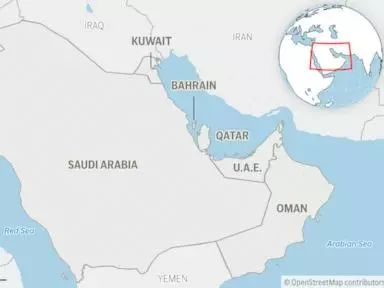
The United Arab Emirates hopes for a diplomatic breakthrough in Qatar-led mediations to prevent a new confrontation between the U.S. and Iran MANAMA, Bahrain -- The United Arab Emirates’ presidential adviser said Sunday that his country hopes a diplomatic breakthrough in Qatar-led mediations is possible to avert a new round of confrontation between the U.S. and Iran. The Iran war, which began on Feb. 28 with joint strikes by the U.S. and Israel followed by attacks by Iran on the Gulf nations, has made it “a watershed year” for the region and the world, UAE presidential adviser Anwar Gargash said at a security forum in Bahrain. Iranian negotiators are in Qatar for talks on a proposal that could reopen the Strait of Hormuz soon, according to Iranian Foreign Minister Abbas Araghchi.
He said that no direct talks are being held with the U.S. and that the final outcome depends on answers provided by the United States to the “Iranian questions.” In an interview shared on his Telegram channel, Araghchi said Iran hoped that the U.S. would choose “diplomacy over other paths.” He said Iran was ready for both defense and diplomacy, depending on Washington’s “rationality.” A possible escalation cast a long shadow over the three-day security forum in Bahrain's capital, Manama. Gargash, the UAE adviser, said that the current crisis requires “a lot of wisdom, with political tools being our main tools, and the understanding that military solutions will only complicate the current very complicated scene that we have and will not actually bring any quick off-ramps.” Gargash, however, acknowledged that “the rules of logic” show that the U.S. and Iranian stances are far apart. He said it's not in the interest of the region or Iran to withstand another round of war.
It was a sentiment echoed by other Gulf and Arab officials at the forum. Egypt's foreign minister Badr Abdelatty, a day earlier, told the gathering: "The second round (of escalation) will be more dangerous, more destructive, and it will lead to nowhere.” But Gargash added that his country and the region are braced for the possibility of escalation. Before a ceasefire was reached in April, the UAE faced the largest number of airborne attacks from Iran, with more than 3,000 drone and ballistic missile attacks targeting airports, military and oil facilities, according to IISS.
Most of those attacks were intercepted. Since then, Gulf nations have spent billions of dollars to boost their defense capabilities. Gargash said that the war has solidified U.S.-UAE relations, making them “even more important” and at the heart of the UAE’s ability to defend itself.
At the conference, Bahraini Foreign Affairs Minister Abdullatif bin Rashid Al Zayani said that his country also welcomes “every effort to reduce tensions, prevent escalation and create opportunities for dialogue.” Al Zayani said that Iran has shown what he called a pattern of attacks or threat of attacks threatening the region’s and the world’s stability and prosperity by targeting sea, air and data facilities. He said Iran has continued to do so even after a ceasefire was reached and as recently as last month, threatening underwater data cables. He described the attacks by Iran-backed Houthi rebels on neighboring Saudi Arabia as part of the pattern.
Navy’s 5th Fleet, at the height of the war, according to IISS. The attacks hit the naval base, residential buildings, the financial district and a water desalination plant. This summer, Houthi rebels have escalated their attacks on Saudi oil infrastructure and airports, saying they were a response to Saudi airstrikes on Sanaa airport.
Extract — continue reading at the source.