This article has been reviewed according to Science X's editorial process and policies. Editors have highlighted the following attributes while ensuring the content's credibility: As cities grow in population, they grow proportionally in terms of infrastructure—new buildings, paved streets and parking lots. Or so says conventional wisdom.
However, a new study by a team of New York University researchers dispels this thinking. The findings, which appear in the journal Nature Cities, show that, in fact, cities' built structures grow more slowly than do their populations, indicating that as urban areas attract more people, these communities are built "lighter." "Our results indicate that many are overestimating the material needed by large cities and that policies limiting density, such as building-height caps, may inadvertently forfeit built-in material savings that come with densely populated urban areas," says Kangning Huang, an assistant professor at NYU Shanghai and one of the paper's authors. "Cities are complex adaptive systems: their material footprint depends both on how big they are and on how people are arranged within them," adds Mingzhen Lu, an assistant professor in NYU's Department of Environmental Studies and the paper's other author.
"Bigger, denser cities are built lighter per person, thanks to shared infrastructure—'urban nests' that stretch from small neighborhoods to megacities. Policies that recognize this urban nesting, rather than judging cities by per capita numbers, can steer urban growth toward a more productive, equitable and sustainable future." Many assume that a city resident, regardless of exact location, requires the same amount of material—meaning that built materials grow proportionally with the population. However, the study found that larger cities consistently hold less built mass per person than smaller ones: a city with twice the population of a comparable city has only about 87% more built mass—rather than twice as much.
Across neighborhoods within cities, the effect is even stronger: a neighborhood housing twice as many people as another makes do with only 68% more built material. The authors point to transportation as an example of this citywide phenomenon. In smaller communities, cars are often the only means of transportation.
By contrast, bigger cities have buses and subway systems, which require less built space per person than cars. This is because a moving car requires 35 square meters (377 square feet) of road space but on average carries only 1.5 passengers, resulting in 23 square meters (248 square feet) of pavement per person. In contrast, a standard bus uses 80 square meters (861 square feet) of road in movement but transports 30 passengers, reducing the per-person material burden to just 2.6 square meters (28 square feet)—a nearly ninefold drop.
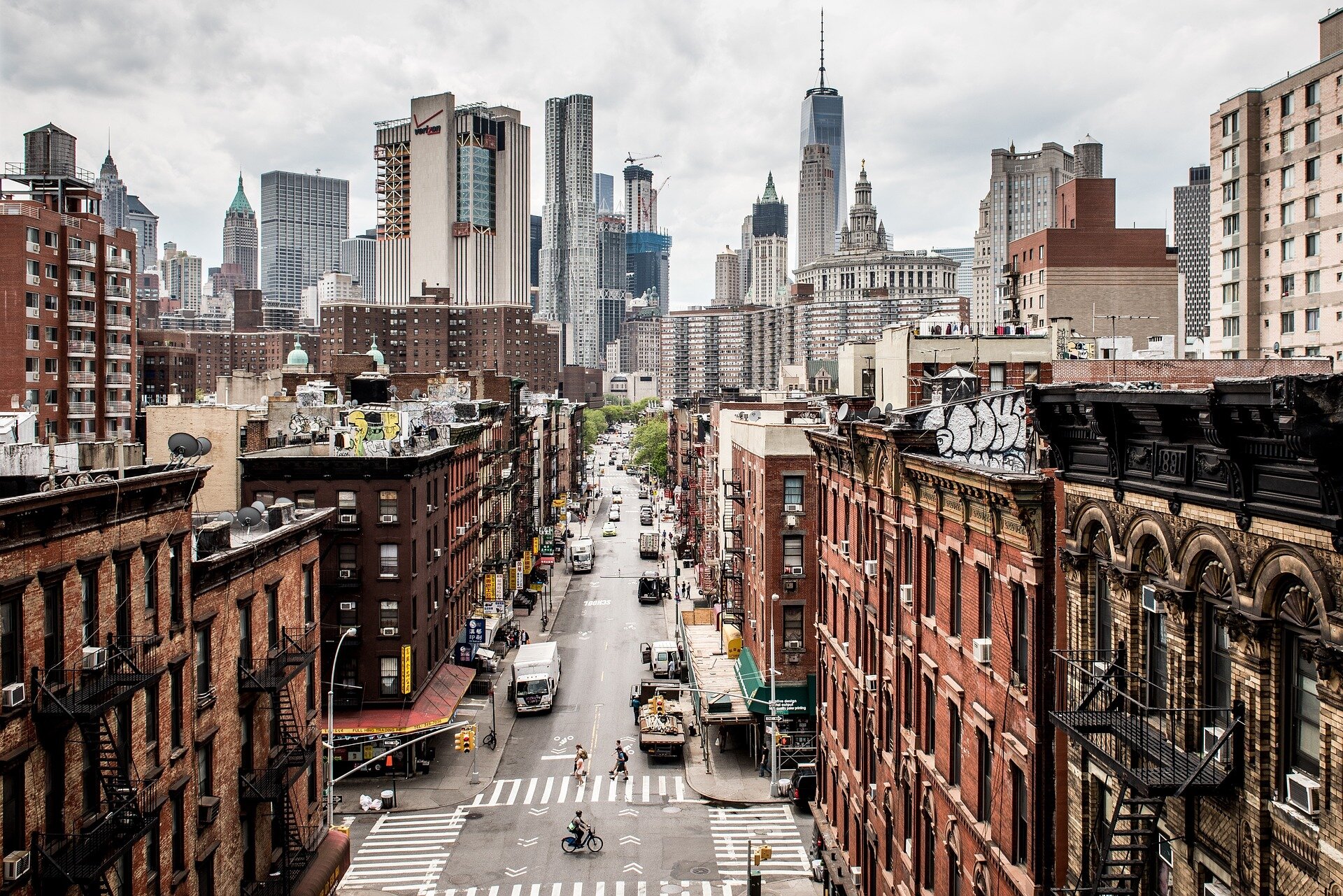
When it comes to neighborhoods, the researchers cite New York City as an example of how densely populated communities and large-city traits work together to make urban areas "lighter." New Yorkers use the same subway system to get around and therefore share the built materials used in the tunnels and trains. This efficiency is complemented by the features of large-city neighborhoods. "In SoHo, Williamsburg, Harlem and Long Island City, people don't just share the subway line, but also share cafes, gyms, laundromats and grocery stores," says Huang.
Extract — continue reading at the source.


