US and Iran trade attacks as Khamenei is buried mourners gather for the burial of Iran's late supreme leader, Ayatollah Ali Khamenei at the Imam Reza Shrine on July 09, 2026 in Mashhad, Iran. Updated 10 July 2026The US and Iran again traded strikes in exchanges that continued into Thursday, as observers reported a "dramatic" drop in the number of ships travelling through the Strait of Hormuz.The US says it hit 90 military targets, some near the Strait. Iran says 14 people have been killed in the past two days.
State media also reported that targets near the Bushehr nuclear power plant were hit, citing the deputy governor of the province. The US has not commented on the latest strikes.Iran said it targeted US assets in Kuwait, Bahrain and Qatar in response. Later on Thursday, Tehran launched more strikes on sites in Kuwait, Jordan and Iraq, state-linked media reported.
Separately, huge crowds gathered as Iran's late supreme leader, Ayatollah Ali Khamenei, was buried after six days of funeral events.The "body of the martyred leader of the Islamic Revolution was buried in the memorial hall of the shrine of Imam Reza," state broadcaster IRIB reported, according to AFP.With crowds waiting outside and listening to prayers, the flag-covered coffin was carried into the shrine of Imam Reza in his home city of Mashhad in eastern Iran. There was no sign of his son and successor Mojtaba Khamenei, who has not been seen in public since he was reportedly seriously wounded in the same attack that killed his father.The crowds was Iranian flags, while some were pictured holding signs carrying death threats directed at US President Donald Trump.Khamenei was killed on 28 February during the first hours of US and Israeli strikes against Iran. eos show damage to the control tower at a major port in the south-eastern Iranian city of Chabahar following US strikesIran's foreign ministry denounced the latest US strikes as a "grave war crime", describing the US administration as "evil and psychopathic"Bridges and a railway route connecting Tehran to the city of Mashhad, where the late supreme leader's funeral is being held, were also damaged, the foreign ministry said.Iran's health ministry said 14 people had been killed and 78 people injured across five provinces.Gulf nations reported Iranian attacks following the US strikes, with explosions in Bahrain's capital Manama, Kuwait intercepting missiles and drones, and Qatar issuing a security alert.Later on Thursday, explosions were heard in Iran's southern port of Konarak, with a local official telling Iran's official news agency a navy site was attacked by an "enemy". However a US defence official told the BBC it had not carried out any strikes in Iran in recent hours.Bowen: For all his bluster, Trump has no better option than talks with IranPublished8 JulyBig fall in oil, gas and cargo ships taking US-backed Hormuz route after new strikesPublished9 JulyResistance and revenge - Iran wanted to send a message with its farewell to KhameneiPublished7 July late supreme leader Ali Khamenei is being held in the city of MashhadIran's parliamentary speaker Mohammad Bagher Ghalibaf, who is also the country's chief negotiator with the US, said on X that America "still hasn't learned that bullying and breaking promises are no longer cost-free"."Let me put it plainly: if you strike, you'll get hit," he wrote, adding that the Strait of Hormuz will only open under Iranian arrangements - not "American threats".US Central Command (Centcom) said the most recent round of strikes was carried out to "further degrade Iran's ability to attack commercial shipping and innocent civilian mariners" in the vital waterway.In a statement, it said it had struck 90 Iranian military targets, which included air defense systems and military logistics infrastructure along Iran's coastline."The latest strikes follow successful execution of offensive strikes in Iran the night before," Centcom added.Phil Belcher, marine director at Intertanko, an international organisation for independent tanker owners, said the number of ships travelling through the Strait via the southern route closer to Oman was now in "single figures" following the step up in hostilities.Belcher added that the overall daily figure of about 30 ships was down from about 70 a week ago and well below the normal number of 130 ships that was seen before the Iran war began earlier this year.He told BBC Radio 4's Today programme that there had been an "exuberance of optimism" around shipping in the region following the signing of the memorandum of understanding between Iran and the US last month, but now the mood has changed."This cycle of violence, this cycle of up-and-down, positive-negative news, it's having an enormous impact both on business [and] on the seafarers themselves," he said. .
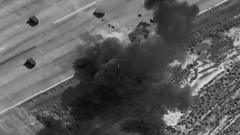
Verified videos show new US strikes on Iran On Wednesday night Iranian state TV reported eight explosions in Bandar Abbas, and said two missiles had hit the ports of both Sirik and Jask - also in southern Iran.It added that two projectiles had hit the island of Abu Musa, which has been the subject of a longstanding ownership dispute between Iran and the United Arab Emirates.The extent of damage from the US strikes is not yet known, but Iranian media have reported power cuts in Chabahar and a fire at an Islamic Revolutionary Guard Corps (IRGC) barracks in Bushehr. Images on social media showed damage to a marine control tower in Chabahar.Earlier on Wednesday, Centcom wrote in a statement that it held Iran accountable for "recent unjustified aggression against commercial shipping and civilian crews freely navigating a vital internation
Extract — continue reading at the source.