President Donald Trump has defended the costly dent the war on Iran has put in U.S. coffers and arms stockpiles by claiming that weapons production could be maintained indefinitely and blaming his predecessor for devoting even more munitions to Ukraine in its battle with Russia. "We have virtually unlimited amounts of Mid to High Grade Ammunition, far more than we could ever use for this, or for any other War (which is highly unlikely!), that could improbably take place," Trump wrote Thursday on Truth Social. "In addition, we are producing Munitions at levels never seen before.
We are stockpiling and preparing for any contingency that could happen. We are taking them for ourselves, the U.S.A., rather than selling them to others, but the sales to Allies will soon again, begin. "Also, please let it be known, that the Biden Administration gave far more Munitions away to Ukraine, at no cost to them, whatsoever, than we have used in Iran," he continued.
"Hundreds of Billions of Dollars was given to Ukraine and NATO, free of charge, that Europe would have paid for — If they were only asked, but we will be asking for that money, though somewhat belatedly!" But the reality of comparing U.S. commitments to two wars launched roughly four years apart and carrying different demands for Washington is more complex. And analysts argue the strain on the U.S. defense industrial base is real, leaving Washington and its partners potentially exposed. "It is clear that the United States is increasingly overstretched between these two conflicts," Christopher Chivvis, a former U.S. intelligence official serving today as senior fellow and director of the Carnegie Endowment for International Peace's American Statecraft Program, told Newsweek.
"This creates windows of opportunity for adversaries, including China and Russia, to exploit." "Trump’s statement that U.S. capacity is 'virtually unlimited' sounds fictional for any relevant time horizon," Chivvis said. "He may criticize the Biden administration for excessive support to Ukraine, but his decision to go to war with Iran has made the situation far worse, including by sapping the military of advanced precision munitions that it needs to deter a PLA invasion of Taiwan." Newsweek reached out to the Department of War for comment, but did not hear back in time for publication. In July, however, Chief Pentagon Spokesman Sean Parnell said in a statement shared with Newsweek for a similar story, “America’s military is the most powerful in the world and has everything it needs to execute at the time and place of the President’s choosing.
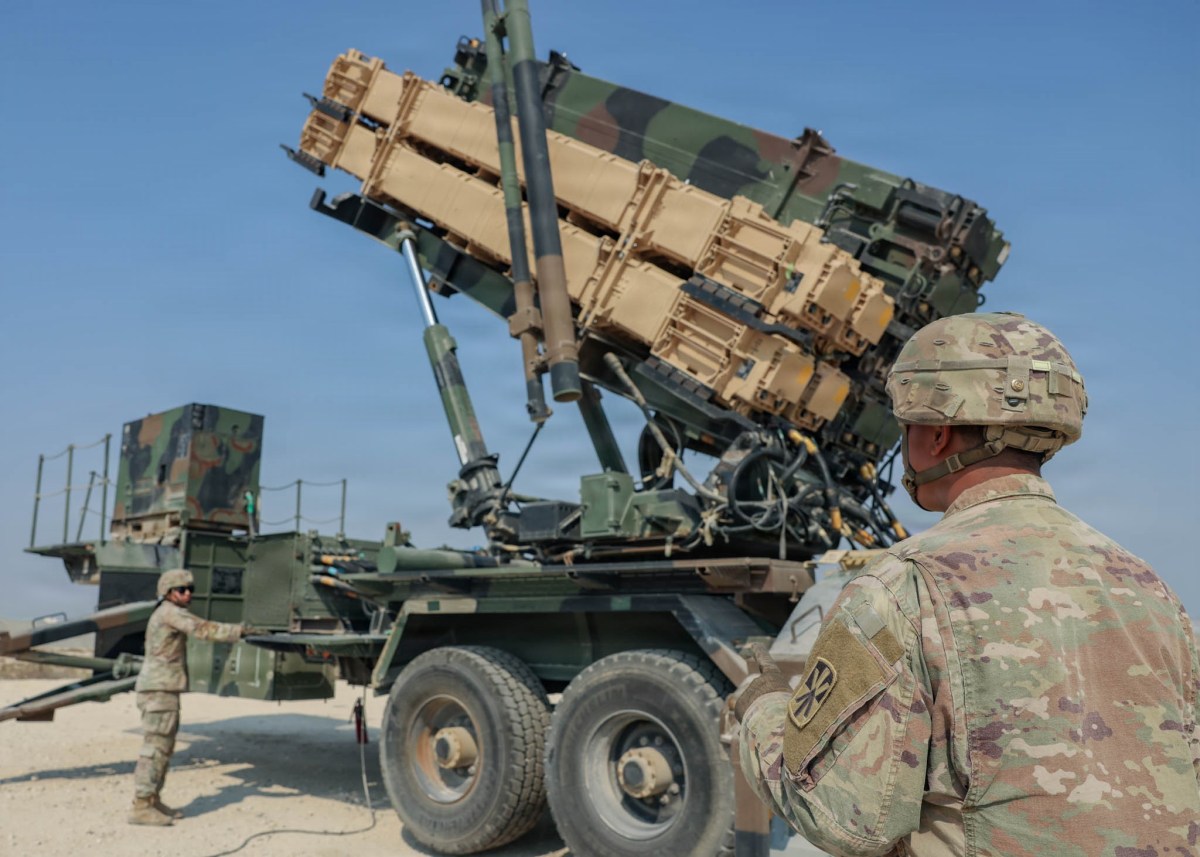
We have executed multiple successful operations across combatant commands while ensuring the U.S. military possesses a deep arsenal of capabilities to protect our people and our interests." From Russia's February 2022 invasion of Ukraine to the end of former President Joe Biden's administration in January 2025, the U.S. committed roughly $66 billion in security assistance, with around $130 billion more devoted to other forms of aid, according to the Department of Defense, later renamed the Department of War under Trump. Weapons provided include more than 4 million artillery shells, hundreds of thousands of mortar rounds, tens of thousands of rockets, and thousands of missiles and precision weapons. The U.S. also sent over 40 High Mobility Artillery Rocket Systems (HIMARS), 12 National Advanced Surface-to-Air Missile Systems (NASAMS), and three Patriot batteries, along with their respective munitions.
Other forms of U.S. military equipment include dozens of tanks, hundreds of other armored vehicles, around 20 helicopters and several other types of vehicles and support equipment. In the initial 39-day period of high-intensity hostilities launched against Iran following the start of the war in February 2026, the U.S. reportedly fired around 1,000 Tomahawk cruise missiles, 1,100 Joint Air-to-Surface Standoff Missiles (JASSM) and between 1,500 and 2,000 interceptors, including those used by Patriot, Terminal High Altitude Area Defense (THAAD) and Standard Missile (SM) systems, according to estimates by the Center for Strategic and International Studies. Significant numbers of other munitions such as Joint Direct Attack Munitions (JDAM), Small Diameter Bombs (SDB) and Precision Strike Missiles (PrSM) were also fired.
Extract — continue reading at the source.