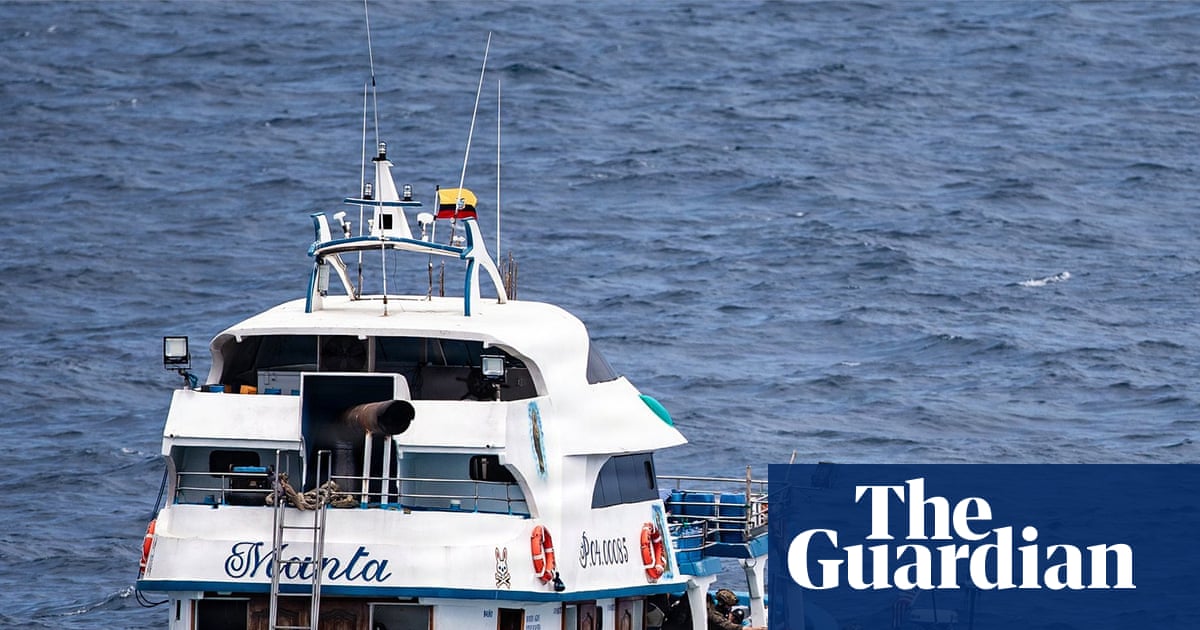
While the US secretary of state, Marco Rubio, was being decorated in Quito by Ecuador’s president for “helping to promote peace in the region”, 10 Ecuadorian fishers whose boat had been blown up by US forces were adrift in the eastern Pacific. On 8 September, a day before Rubio arrived, a US patrol vessel intercepted the fishing boat Don Rufo in international waters near Ecuador. But another 10 crew members were fishing farther out to sea in a smaller boat that was not equipped to make it back to shore.
The Ecuadorian navy only rescued them on 10 September, when Rubio was already in Peru preparing to return to the US. US Southern Command posted an edited 14-second video of the operation and said “intelligence confirmed” that the vessel was being used by a gang as a “floating refuelling station” for speedboats allegedly carrying drugs – which the fishers deny. It was one of eight operations involving Ecuadorian boats in just more than two weeks – the latest on 16 September – to follow the same pattern.
Unlike the nearly 70 US airstrikes in the Pacific and Caribbean that have killed 234 people since last year, crews were removed before the vessels were sunk. Also, rather than unilateral US attacks, the new wave of operations has the open support of Ecuador’s far-right president, Daniel Noboa, who is calling them “joint operations”. Donald Trump has compared the drug trafficking operations to the campaign against the Islamic state.
Some analysts see the shift as an indication that the US’s military strategy against drug trafficking in Latin America has entered a new phase. Although Ecuador does not produce cocaine like neighbouring Colombia and Peru, over the past decade it has become a major trafficking hub because of its access to the Pacific, including the area where the attacks on boats have been taking place. Noboa has responded with a controversial “iron-fist” approach to the gangs, issuing repeated states of emergency and expanding the role of the armed forces.
This crackdown however has done little to reduce violence, and instead has eroded human rights. The most notable example of human rights abuse came last year in the case of the “Guayaquil Four”, the forced disappearance of four Afro-Ecuadorian boys between the age of 11 and 15. All four boys were found dead, there bodies charred and dismembered.
Despite pushback from voters, Noboa signed an agreement with the White House authorising joint operations and granting US military personnel involved in counter-narcotics operations immunity from criminal prosecution. The operations have also extended to land, with US troops taking part in raids last Thursday. Trump has pressured Latin American presidents to join an anti-drug cartel coalition he created called Shield of the Americas.
Extract — continue reading at the source.