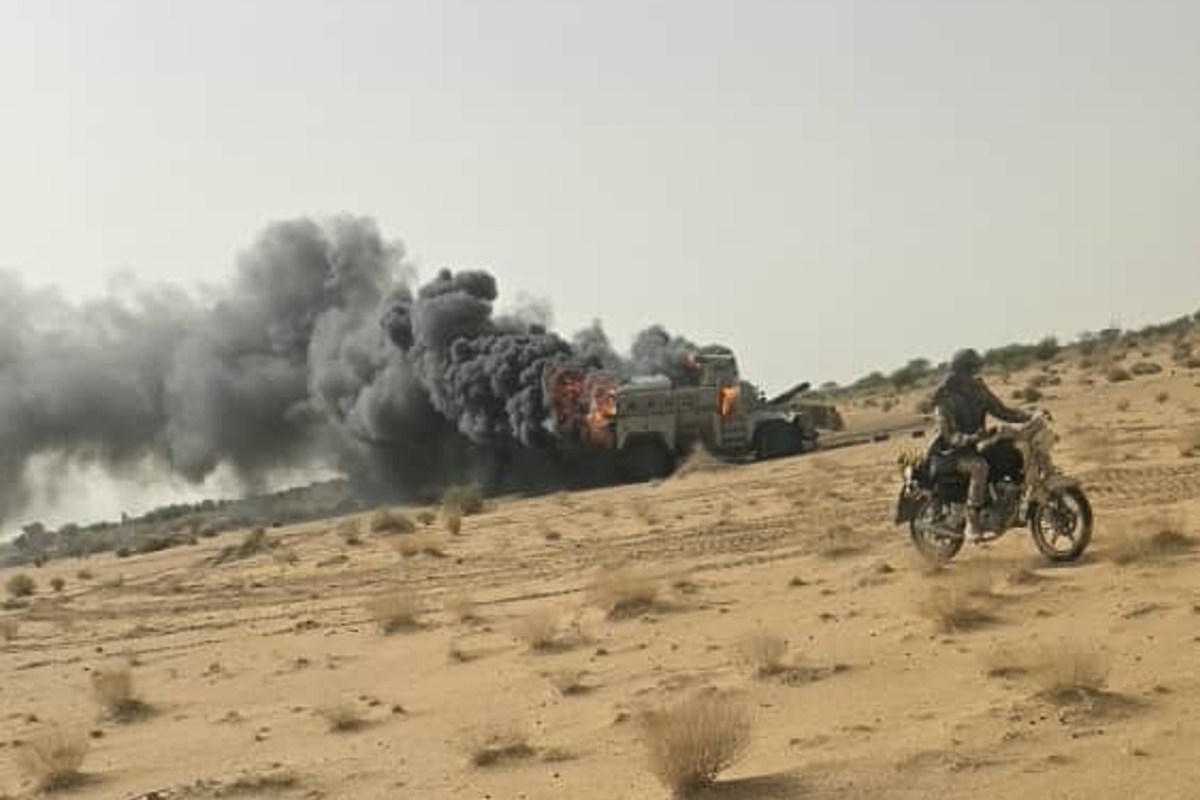
As the United States prepares to remember the 25th anniversary of 9/11, militants affiliated with Al-Qaeda and the Islamic State (ISIS) are gaining ground in one region of the world that receives little attention from Washington. More than 59,700 people have been killed in Africa's Sahel region over the past decade by Islamist militant groups, according to a recent Africa Center for Strategic Studies report drawing on figures from the Armed Conflict Location & Event Data (ACLED) monitor. The Institute for Economics & Peace's latest Global Terrorism Index found the region accounted for more than half the world's terrorism-related deaths last year.
Africa Command (AFRICOM) now assesses Africa to be "the epicenter of global terrorism," with Al-Qaeda and ISIS affiliates active in the Sahel and Lake Chad Basin "having the intent to strike the U.S. homeland and our interests," an AFRICOM spokesperson told Newsweek. The threat is already spreading. Analysts warn that militant groups are capitalizing on local grievances, battlefield successes and other factors to consolidate and expand their deadly reach.
"The most concerning trend is the continued growth of jihadist groups across West Africa, reflected in their consolidation of territorial influence and their ability to sustain multi-front campaigns across several countries against government forces, local militias, and foreign partner forces, as well as fighting each other in competition for regional dominance," Héni Nsaibia, ACLED's senior analyst for the Sahel, told Newsweek. "Their capacity to mobilize forces for large-scale operations has also become increasingly apparent." One group in particular stands out for its ruthlessness and battlefield prowess in the Sahel: Jama’at Nusrat al-Islam wal-Muslimin ("the Support Group for Islam and Muslims"), better known as JNIM. JNIM is affiliated with Al-Qaeda, the same group behind the devastating 9/11 attacks, and it's only intensified its campaigns in the central Sahelian countries of Burkina Faso, Mali and Niger, threatening to bring instability to the broader region and potentially beyond.
Nsaibia described JNIM as "unmatched in its use of siege and economic blockade tactics." Al-Qaeda has long been an international project, with Africa serving as a historic hub for its activities. Having been founded in the 1980s by Osama bin Laden among Arab volunteers fighting alongside U.S.-backed Afghan mujahideen against Soviet intervention in Afghanistan, the group established some of its earliest networks in Sudan in the early 1990s, going on to kill more than 200 people in the 1998 bombings of the U.S. embassies in Kenya and Tanzania. Liam Karr, Africa team lead for the American Enterprise Institute's Critical Threats Project, told Newsweek that today "JNIM poses the greatest regional threat, as it already has support networks in the coastal countries neighboring the epicenter of the insurgency in the landlocked Sahelian countries." He argued that Al-Qaeda's affiliate in the Sahel has primarily focused "on its local struggle and any actor supporting the local Sahelian militaries." This campaign involves coordination with other non-state actors such as the Tuareg separatist Azawad Liberation Front, which has recently engaged in major joint assaults alongside JNIM against Malian troops and Russian Africa Corps private military operators.
JNIM has also incorporated or secured ties with a number of other Islamist factions in the Sahel, including Ansarul Islam, Katiba Macina and Katiba Hanifa. Beyond the Sahel, Al-Qaeda in the Islamic Maghreb is active in both North and West Africa, while the al-Shabab militant group operates with Al-Qaeda affiliation in East Africa, primarily Somalia. "While this may not be translating to major attacks now," Karr said, "militant groups have repeatedly shown that these support networks can be quickly operationalized for attacks when the group or their local fighters choose to do so." But another global jihadi group that seized the spotlight of Islamist terrorism in the Middle East from Al-Qaeda more than a decade ago has also made violent inroads in the region, with aims that stretch far beyond.
ISIS emerged from the remnants of Al-Qaeda in Iraq roughly a decade after the U.S. invasion of 2003, eventually breaking with its parent organization and surpassing Al-Qaeda in forging a sprawling network of affiliates around the world. As with Al-Qaeda, ISIS has invested heavily in its Africa presence and its supporters across the continent have only ramped up operations in the years since its self-styled caliphate was brought down in Iraq and Syria by local forces and their international partners, including the U.S., Russia and Iran. In the central Sahel region, the Islamic State Sahel Province (ISSP), formerly known as the Islamic State in the Greater Sahara, has emerged as a particularly volatile actor.
Extract — continue reading at the source.