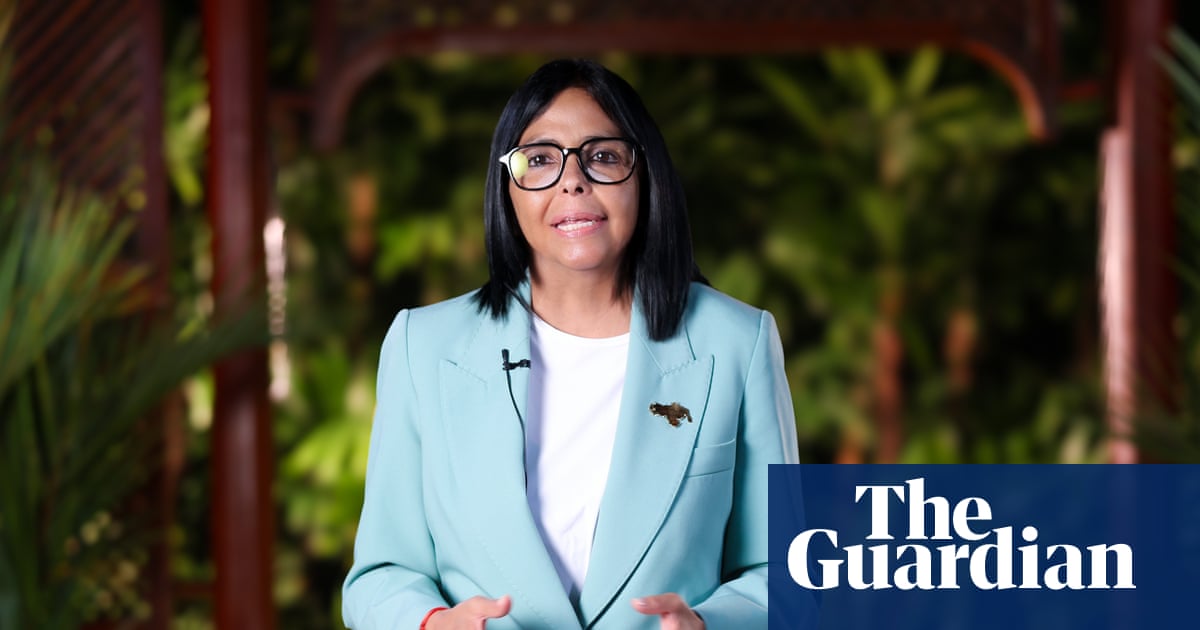
Venezuela’s interim president, Delcy Rodríguez, has defended her government’s highly controversial energy deal with Donald Trump, insisting the South American country will maintain ownership and sovereignty over its massive oil reserves. Rodríguez, who assumed power in January after Trump ordered the abduction of the president, Nicolás Maduro, took to the airwaves on Saturday to push back against criticism of what the US president has called “the biggest oil deal in world history”. During a six-minute television broadcast, Venezuela’s acting leader claimed the deal would help her resource-rich country develop its economy, earn revenues of more than $209bn (£154bn), and become “an energy powerhouse”.
Rodríguez said: “As everyone knows, our country has the biggest oil reserves in the world. But having resources underground isn’t enough. We need investment, technology, infrastructure [and] production capacity to convert this wealth into wellbeing for our people.” She added: “It’s no use having our oil reserves underground, only to appear in statistics or bookkeeping … and for us not to be able to convert and translate them into development for Venezuela.” Trump announced the “groundbreaking” deal on Friday, calling it a “historic transaction [that] more than doubles American oil reserves … while helping to continue to set Venezuela on a course toward Tremendous Success and Great Prosperity”.
On Sunday, Trump wrote on his Truth Social platform: “One of the things I am going to do with the Venezuelan Oil is fill up the Strategic National Reserves which, because of Sleepy Joe Biden, has been virtually emptied.” Trump added: “The ‘topping out’ process will begin very shortly, and is a Gift from Venezuela to the People of the United States.” Hours after seizing Maduro on 3 January, Trump warned Rodríguez she would face an even worse fate if she failed to toe the US line. Details of the agreement – struck during months of secret talks – remain sparse but it will reportedly see Washington take control of 65bn barrels of Venezuelan oil reserves. The South American country has the world’s largest proven crude oil reserves, with an estimated 303bn barrels, compared with Saudi Arabia’s 268bn and Iran’s 208bn.
Rodríguez said the deal involved 17 “strategic oilfields” where it was hoped more than 1.5m barrels could be produced each day. But the deal has provoked outrage, both among members of Venezuela’s opposition and within the Chavismo political movement of which Rodríguez is part. Speaking on Friday, one prominent opposition figure, who asked not to be named, called the agreement “a massive land grab” by a “rapacious, mafioso United States”.
Writing on X, Rafael Ramírez, the former head of Venezuela’s state-owned oil company PDVSA, accused Rodríguez’s administration of “driving a dagger straight into the heart of the homeland” with the “neocolonial” transaction. That has never happened in Venezuela, and I think nowhere else in the world,” Ramírez added in an interview with the newspaper El Nacional. On Saturday, dozens of leftwing protesters marched through Caracas with banners reading: “We are neither a colony, nor a backyard” and “Yankees go home!” Critics of the agreement shared an ironic meme on social media suggesting the state oil company’s name should be changed from PDVSA to “PDUSA”.
In her broadcast, Rodríguez, the daughter of a Marxist guerrilla who spent years denouncing “imperialist” attempts to snatch her country’s oil reserves, countered claims she was surrendering Venezuela’s natural resources to a foreign power. She thanked Trump and the US secretary of state, Marco Rubio, for striking the deal but added: “There is something that must be made absolutely clear: Venezuela retains the ownership and sovereignty over its resources.” “We are thinking of Venezuela’s future,” claimed the politician, whose country was plunged into authoritarian rule and one of the world’s worst peacetime economic crises during Maduro’s 13-year rule. The deal represents an astonishing U-turn from Rodríguez and the socialist, anti-imperialist political movement she and Maduro inherited from Hugo Chávez after his death in 2013.
Extract — continue reading at the source.