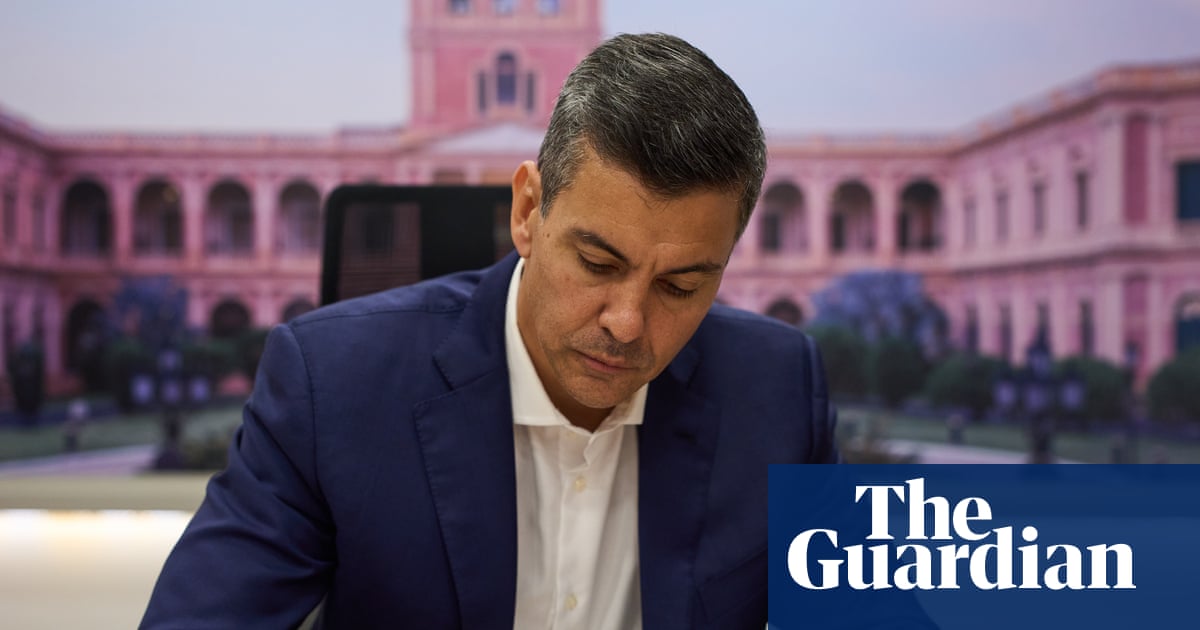
Pedro Volpe had just woken up last Tuesday when he saw a message from a friend asking whether his bank account was down, too. It was a day after payday, and Volpe, 50, a writer and lawyer, opened his banking app and panicked: he could not even see his balance. Volpe was among nearly 3 million Paraguayans, about 60% of the country’s adult population, whose accounts had been frozen overnight.
All were customers of Ueno Bank, a digital lender that aggressively expanded across the South American country in recent years, and which, on Monday night, the central bank ordered into resolution over insolvency. Ueno is at the centre of a political and economic crisis that has brought Paraguay’s banking system to the brink of collapse. On Friday, it led to the impeachment and house arrest of the rightwing president, Santiago Peña.
Peña had resigned the day before in a vain attempt to retain the special jurisdiction afforded to former presidents – who, under the constitution, become senators for life. Lawmakers stripped him of the seat anyway, meaning Peña will face criminal proceedings in the ordinary courts. In just a few days, he went from being a market favourite among Latin American presidents and one of Donald Trump’s key allies in the region to facing fierce mass protests, being voted out and placed under house arrest.
The now former president is the subject of an investigation by the public prosecutor’s office over alleged favouritism towards Ueno, which, in just a few years since Peña took office in 2023, went from an obscure digital lender to the bank of choice for most Paraguayans. The bank also offered far more generous investment returns than its competitors did. I don’t know what I’ll do next week.” Ueno was so popular – sponsoring the national football team, the league and the country’s biggest football clubs – and served such a large share of the population that businesses have already reported an overall fall in sales of up to 80% this week.
Media outlets belonging to the same financial group as the bank had their operations suspended, including radio stations and the century-old newspaper La Tribuna. The impact on ordinary Paraguayans was perhaps even wider reaching. The media freeze saw 300 workers having their salaries suspended, initially for 90 days.
About 32,000 pensioners whose public pension funds had been invested in the bank were left without payments. Soon after taking office at age 44 as the youngest president in Paraguay’s democratic history, he appointed Carlos Carvallo Spalding, who had until then been Ueno’s CEO, to lead the central bank. Less than three months later, Spalding authorised Ueno, then a finance company, to become a digital bank.
Extract — continue reading at the source.