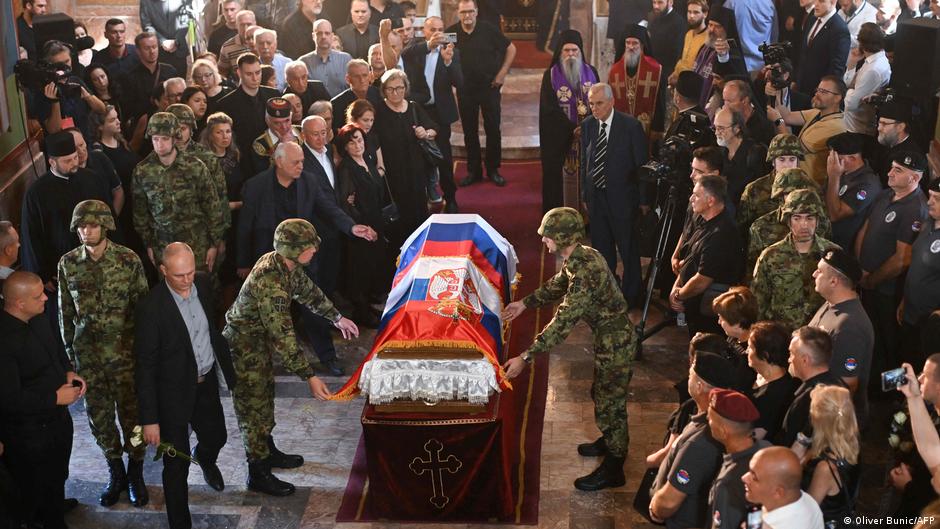
Several thousand people lined the streets of Belgrade on Monday to follow the funeral service and burial of former Bosnian Serb army commander Ratko Mladic. Earlier in the day, Serbian Patriarch Porfirije personally officiated at the funeral service for the former general, who died while serving a life sentence in The Hague for genocide in Srebrenica and other war crimes committed during the violent breakup of Yugoslavia in the 1990s. In accordance with his wishes, Mladic was laid to rest at Topcider Cemetery beside his daughter, who died by suicide in 1994.
Informer TV, a staunchly pro-government broadcaster, carried live coverage of what it described as a "magnificent farewell," without mentioning the roughly 8,000 Bosniak civilians and prisoners massacred by Mladic's Bosnian Serb forces in Srebrenica in July 1995. President Aleksandar Vucic did not attend the funeral, citing a previously scheduled visit by his counterpart from Uzbekistan. Observers say that the president has tried to chart a middle course on the issue of Mladic's funeral.
Mladic was not buried with state honors, but with military honors, with Vucic insisting that the state was merely respecting the wishes of the family and ensuring a dignified burial. "Were we supposed to forbid people from attending, forbid the funeral itself and create dog cemeteries?" he said in response to criticism from the EU. The phrase "dog cemeteries" refers in Serbia to the unmarked graves of so-called "enemies of the people" who were executed by Yugoslav partisans during and immediately after World War II.
Vucic was equally dismissive of the decision by EU Enlargement Commissioner Marta Kos to cancel a planned visit to Belgrade, calling her reaction "stupid." He has brushed aside other criticism of the public glorification of Mladic in much the same way. An EU spokesman said in a statement that "Any glorification of war criminals, genocide denial and revisionism contradict the most fundamental European values and have no place in the EU or in EU candidate countries." For Vucic, who has long sought to balance Serbia between the European Union and Russia, the situation is politically delicate. He is expected to call a snap parliamentary election as early as this week.
The poll is likely to take place on October 25. For the first time in years, there is a credible possibility that his ruling bloc could be defeated by the student movement, which has led anti-government protests in Serbia for nearly two years now. Vucic is expected to head the list of his Serbian Progressive Party as its candidate for prime minister.
According to Dejan Bursac, a political scientist at the Institute for Philosophy and Social Theory in Belgrade, all signs point to a president increasingly anxious about the upcoming vote. "Vucic is grasping at every available lifeline," Bursac told DW. "One of those lifelines is Mladic's funeral and the nationalism it can help generate, allowing Vucic to present himself as a patriot while portraying his political opponents as traitors." Many Serbs, Bursac said, still feel deep resentment over the outcome of the Yugoslav wars and claim that crimes committed against Serbs during these wars largely went unpunished.
Extract — continue reading at the source.