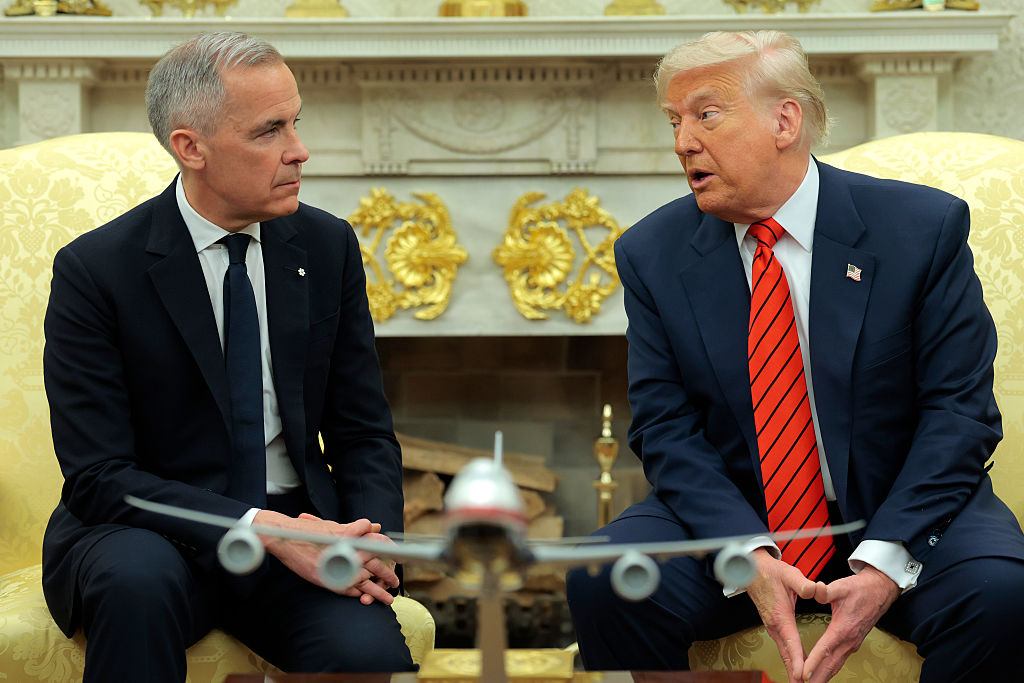
President Donald Trump threatened to raise automobile tariffs on Canada to 50% as the trade rift and political slanging match between the neighboring nations escalated. Trump announced Monday morning that U.S. tariffs on all Canadian cars and trucks, automotive parts, and steel will increase to 50% starting Jan. 1, 2027. Canada will be treated like a State no longer!
On trade, and in other ways, also, they are among the worst nations in the world to deal with,” he said on social media. Trump’s comments came after trade talks between the two countries broke down, with each side accusing the other of making eleventh-hour demands that derailed negotiations. However, negotiations broke down on Friday, and the Administration's 50% tariffs on about $20 billion worth of imports into the U.S. from Canada took effect Saturday.
Canadian Prime Minister Mark Carney vowed to match the U.S.’s tariffs “dollar for dollar.” “We are stronger now than when the United States started this trade war. More unified, more determined, and more ambitious,” Carney said during a press conference Saturday, referring to the year-long trade rift that has come to affect both countries. And promised: “That will never, ever happen.” We are keeping that promise.
Canada is becoming stronger and less dependent on America.” Both sides have since blamed the other for making unreasonable demands late in the negotiating process. Trade Representative Jamieson Greer, meanwhile, framed the breakdown in negotiations as leaving the U.S. with little choice but to retaliate against Canada. Our interest is in protecting American workers and protecting American supply chains,” he told "Fox & Friends" on Saturday.
Greer said the Republican Administration had offered to cut tariffs on steel, autos, and lumber, “things that are sensitive for them. And they’ve always had the best deal, and they still would have an even better deal, but they didn’t want that.” As a result, he said, “We’re moving forward with measures that respond to Canadian retaliation.” The broader 50% tariffs that took effect Saturday were initially announced in July, and would affect around 5% of trade between the U.S.-Canada. Shortly after the collapse of the talks, Trump took to Truth Social on Sunday and said that Canada “wants the benefits of being a State, without being one” and that it has “also charged our great farmers, for many years, massive amounts of tariffs.
No more!!!” Despite not being clear what the President meant, Trump has repeatedly expressed his desire to annex Canada and make it the 51st U.S. state—an idea Carney has strongly rejected. The collapse of the deal and escalating trade tensions between Washington and Ottawa have been met with both praise and criticism on either side of the border. Ontario Premier Doug Ford praised Carney for standing firm and refusing to accept what he described as a “bad deal.” “It was a bad deal for Ontario.
Extract — continue reading at the source.