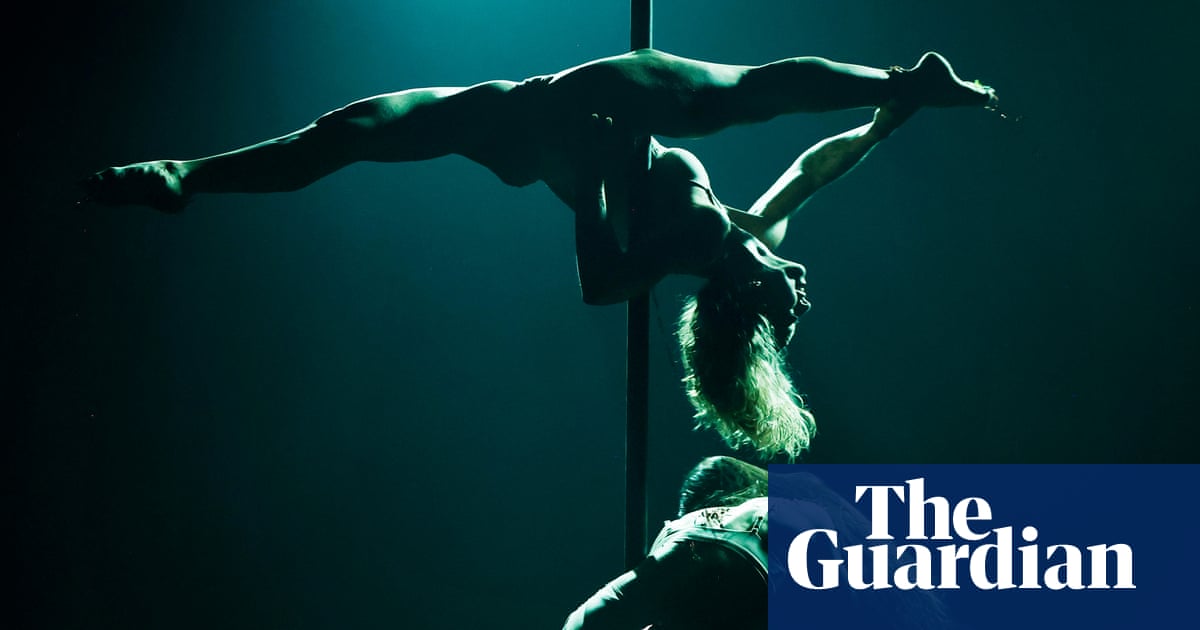
If you tell someone in Edinburgh you’re going to see a pole dancing show, they might direct you towards the so-called Pubic Triangle, where the city’s strip clubs are. But there’s more to pole dance than that – and it’s popping up in theatre shows across the fringe this year. Not only do these acts show off amazing physical feats, they also tell stories that range from one woman’s HIV diagnosis, to the relationship between a neurodivergent mother and son.
Since the boom of the 1990s, when Zoe Ball famously had a pole in her living room, pole has been taught at dance studios, has become a competition sport – there’s a campaign to get it into the Olympics – and made its way from cabaret stages to theatres. It’s an impressive and fiendishly difficult art. Gina Alm saw a video of a pole dancer on YouTube when she was 15 and immediately knew she wanted to do it.
You can do things that appear to defy physics. It’s magnetic to watch and I saw a lot of potential in it, immediately, as an art form.” Yvonne Smink came to pole dance having been a climber, and transferred her grip, strength and balance to this new discipline (she’s since won multiple Dutch championship titles). She says for her it’s a kind of movement therapy.
It’s like time stops.” Smink calls herself a dinosaur, having been in the industry a long time. It came from the strip clubs. Now it’s like a whole revolution happening.
It’s exciting for me to see.” “I think pole really contains multitudes,” says Alm. It can be an art piece or a piece of dance theatre.” In Edinburgh, Alm is performing Dusk/Night/Dawn alongside US national pole art champion Donna Carnow, whose background is in contemporary dance. The pair both work on the New York cabaret scene and their show is a dreamlike journey through the world they inhabit.
It’s a show about the act of entertainment, and the grind of a dancer’s life: “Our lives and our labour.” The pair recall finding themselves on all sorts of stages, at all hours of the night. She pretzels her limbs into knots around the pole, at speed, suspended seemingly by just the arch of a foot, a hip, an elbow. As well as the hanging pole, there’s the static pole and the spinning pole.
Extract — continue reading at the source.