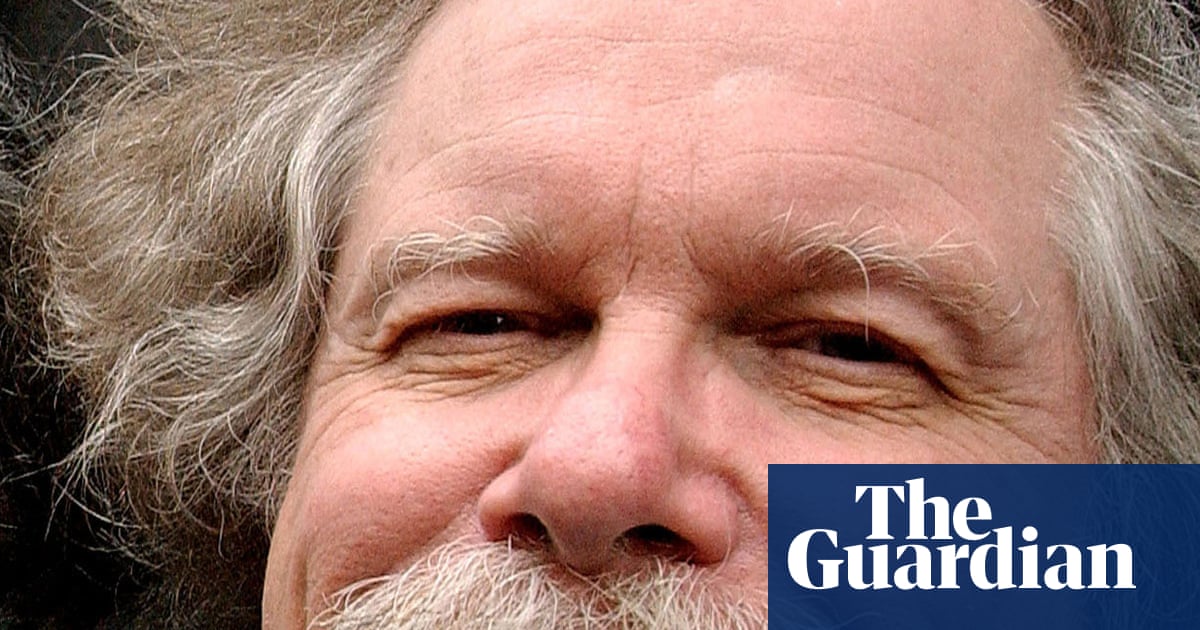
Sanders is an American maverick; a musician, poet, activist, journalist and author whose greatest hit remains his bestselling 1971 book The Family, in which he chronicled the lives, crimes and trials of Manson and his followers. Sanders was well placed to report on crazed hippies, having played a pivotal role in launching the US counterculture – though he very much espoused peace, love and consciousness-raising, rather than Manson’s apocalyptic worldview. I don’t subscribe to apathy and nihilism.” Aged 87, Sanders is speaking with me as Fugs Film!, a feature-length documentary about the Fugs, the offbeat folk-garage-psych band Sanders initially led from 1964-69, and re-formed in the 1980s, gets its UK premiere this week.
And often they are wanting access only because I knew Jimi Hendrix and Allen Ginsberg and Andy Warhol and Janis Joplin and …” He shakes his head. We gave him his first wah-wah pedal. Nice, talented guy”), to name just a few of his associates.
In concert, the Fugs shared bills with the Velvet Underground, the Stooges and the Grateful Dead, but the biggest impression was made by a then unknown band who opened for the Fugs in Detroit’s Grande Ballroom in March 1968. When we came on, everyone was limp, worn out by how high Sly had taken them.” Sanders and his bandmates Tuli Kupferberg and Ken Weaver were rudimentary musicians who fused street theatre and dadaist spectacle with poetry and ramshackle songs. Long-haired, anti-war, pro-drugs and articulate, the Fugs attracted plenty of media attention but never troubled the Top 40 and are relatively little known today, so Fugs Film! allows a fresh look at a band at the heart of a nascent counterculture.
Blending archive footage with contemporary interviews, director Chuck Smith’s film focuses on New York when it was a cheap city to live in, and many artists shared the absurdist mentality of the west coast’s “merry prankster” dropout hippie-artists. Inspired by Ginsberg’s epic poem Howl, Sanders had hitchhiked from Kansas to New York City as a teenager. We formed the Fugs to blend poetry with rock’n’roll after seeing beat poets dancing to a jukebox playing Martha Reeves and the Vandellas and the Beatles.
It seemed an obvious thing to do.” Sanders’ literary leanings meant he also ran the city’s Peace Eye Bookstore and published the cheaply mimeographed zine Fuck You/A Magazine of the Arts, which featured writing by Burroughs, Norman Mailer, Ginsberg and other beat poets such as Gregory Corso. I sent copies to Picasso, Beckett, Sartre, Castro and Khrushchev inviting contributions, but none of them replied.” He laughs at his youthful audacity, adding that he did get attention from the NYPD, who attempted to prosecute Sanders for obscenity: Fuck You was frequently, cartoonishly sexual. Sanders was “fighting for free speech alongside the beats and Lenny Bruce,” he says.
The musicologist Harry Smith produced the Fugs’ eponymous 1965 debut album for the Folkways label. The band shifted to ESP-Disk, home to free jazz pioneers Albert Ayler and Sun Ra, but neither label had any commercial heft, so Sanders was overjoyed when Jerry Wexler of Atlantic Records – who had helped make Ray Charles a star and was about to do the same with Aretha Franklin and Led Zeppelin – signed the band. Yet on hearing the finished masters, Atlantic dropped them.
Extract — continue reading at the source.