Recent fretting about the uncontrolled pace of AI development has investors and U.S. officials nervous that the industry could soon shift into a lower gear—and potentially slow the entire American economy along with it. In recent days, leading AI figures like OpenAI CEO Sam Altman and Anthropic’s Dario Amodei have warned that breakneck advances have created an imminent risk of rogue AI “swarms” capable of “taking over the entire internet.” This came after former developers, notably—former Anthropic researcher Jacob Coxon—warned that frontier systems could pose an existential threat to the human race and that companies pioneering the tech were failing to comprehend these dangers. In an essay titled “We Must Pace the Frontier,” Amodei called on governments and fellow developers to put in place safeguards and “slow the pace at which we improve the capabilities of AI models.” Other notable names, including Elon Musk and Google DeepMind CEO Demis Hassabis, have echoed his calls, though Mark Zuckerberg and Nvidia’s Jensen Huang have rejected proposals to rein in development.
And President Donald Trump has dismissed such existential concerns as a “hoax” and “sick conspiracy” that will let China pull ahead in the AI race—having in the past defended data centers as critical to the U.S. economy. Whichever side time proves correct, the staggering investments made in the technology and its associated infrastructure mean that the U.S. economy and AI have become increasingly tethered, and that any changes when it comes to developing and rolling out the latter will inevitably reverberate through the former. If you own an S&P 500 index fund, around one-third of your money is currently tied to seven stocks—the “Magnificent Seven”—nearly all of whom have become major players in the AI space.
The group, which includes Nvidia, Alphabet and Meta, represents some 34 percent of the index’s overall value, according to recent calculations by the Motley Fool, and technology has therefore been credited with the gains recorded by U.S. stocks in recent years. But an observed disconnect between investor enthusiasm and the technology’s realized—or even realizable—returns has aroused fears of a “bubble” forming in the market that, when popped, could lead to a crash similar to that which followed the late-1990s Dot-Com Boom. In a recent analysis, Fitch Ratings estimated that a “severe AI-related equity price shock” alongside a sizeable drop in AI-related capital expenditure could push the U.S. economy into a recession and drag down economic growth worldwide.
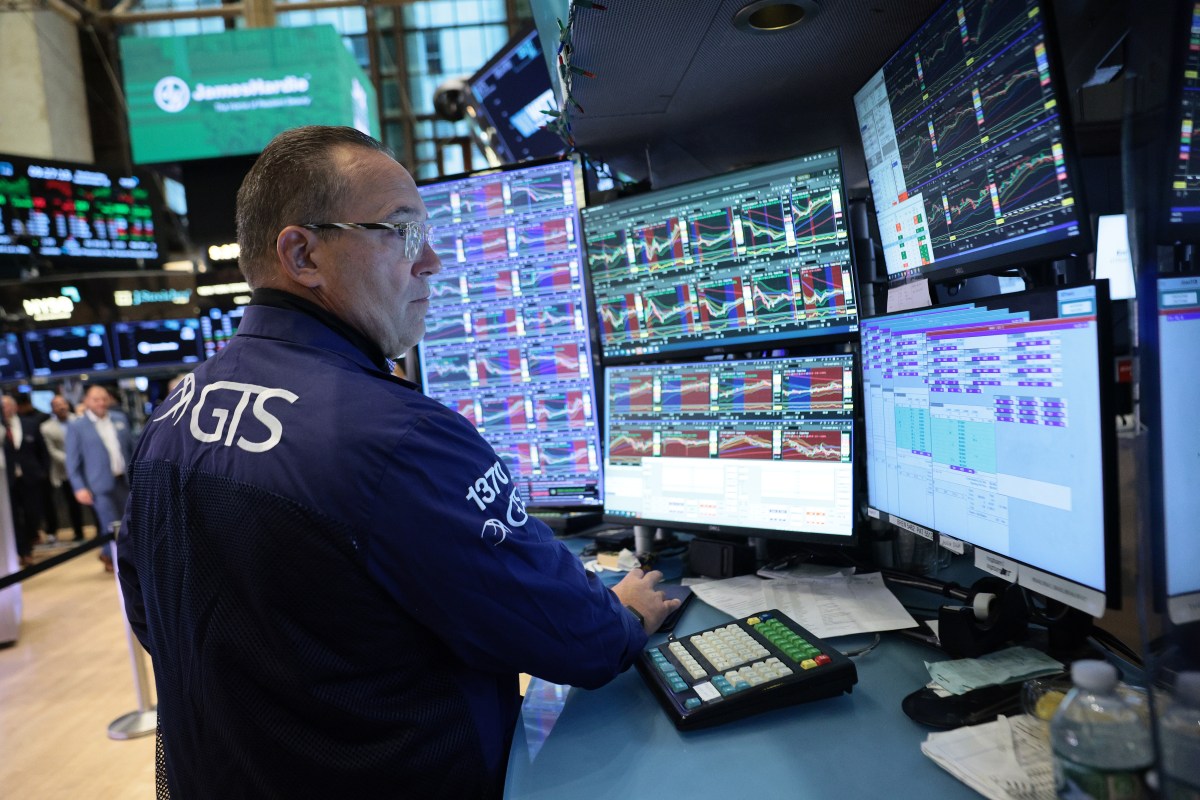
After leading AI figures began issuing warnings over AI’s potentially apocalyptic capabilities, this week began with a sharp selloff of tech stocks that analysts said were reflecting fears of such an imminent slowdown. When frontier lab executives publicly call to slow capability advances, markets immediately downgrade those forward growth assumptions,” said Ben Charoenwong, a professor of finance at INSEAD’s business school campus in Singapore. However, Charoenwong said that this selloff “reflects a downward adjustment in growth expectations,” and was not confirmation that the AI bubble—if it exists—was popping.
Markets aside, AI and the ongoing “buildout”—creating the infrastructure needed to train and run it—is playing an increasingly central role in parts of the economy, implying that a swift pullback in AI spending could itself carry major financial consequences. An analysis published in January by the St. Louis Fed noted that investments in software, R&D, computing equipment and new data centers were proving an “important driver of growth,” and contributed “significantly” to gross domestic product (GDP) last year.
Mark Zandi, chief economist at Moody’s Analytics, has calculated that AI and associated spending is fueling around a quarter of the country’s otherwise paltry economic growth, while The Economist last year cited estimates that the contribution to GDP growth could be as high as 40 percent. And in its mid-year outlook published in June, the U.S. investment firm KKR predicted that AI-related economic growth could become “more extreme than anything we have seen since the start of the second industrial revolution in the 1870s.” However, the company predicted that this would be concentrated across only a handful of sectors. Manufacturing has been one such case, and in addition to raw economic momentum, businesses have credited the AI buildout with holding up otherwise shaky parts of the American labor market.
Extract — continue reading at the source.