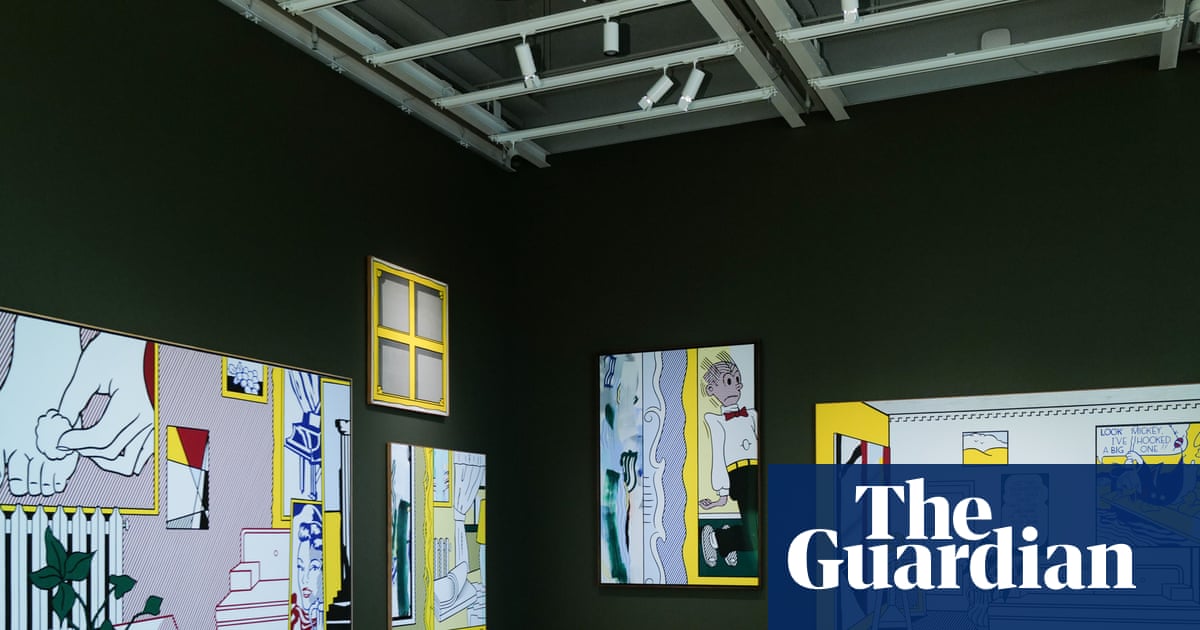
When the American artist Roy Lichtenstein created his monumental Greene Street Mural in 1983, he took inspiration from the Bayeux tapestry for its serial storytelling technique. But whereas the embroidery depicting the Norman conquest continues to delight after nearly 1,000 years, Lichtenstein’s site-specific mural was destroyed after six weeks, in accordance with his wishes. More than four decades later, however, the monumental Greene Street Mural is to mesmerise art lovers once more.
This week a 96ft (29-metre) recreation of the work will span the entire entryway to Roy Lichtenstein: Like New, the first major New York retrospective of the pop artist’s work in 33 years, at the Whitney Museum of American Art. It’s tied to this idea of the frame-by-frame and a kind of serial mode of storytelling that we understand very well now through scrolls and so many photographs.” The exhibition boasts more than 130 works spanning six decades, from early 1940s studies to unfinished canvases that Lichtenstein left in his studio at his death in 1997. The museum’s connection to Lichtenstein dates back to 1965, when his work was first featured in a Whitney annual exhibition.
It was the artist’s widow, Dorothy, who championed pairing an in-house curator, Meg Onli, with an active contemporary artist, Da Corte, to conceive a contemporary retrospective that would innovate beyond a mere conventional survey. Known for his immersive installations that critique visual media and consumer culture, Da Corte had a long interest in pop art. He recalls: “You ask yourself, what do you think of an artist so ubiquitous as someone like Roy?
What could be discovered? What is new there?” If the public remembers Lichtenstein primarily as a cool ironist who lifted images from romance comics and chewing gum wrappers, Like New exposes a more rigorous and complex artist. At the heart of the exhibition’s thesis is Lichtenstein’s lifelong obsession with an obscure academic mentor: Hoyt Sherman, a professor at Ohio State University.
Lichtenstein studied under Sherman in the 1940s before returning to teach alongside him. Across his career, until his death in 1997, Lichtenstein repeatedly cited Sherman as his single greatest influence. Yet Sherman’s radical teaching methods had been underplayed in previous museum retrospectives.
To understand Lichtenstein’s mechanics, Onli and Da Corte travelled to the Ohio State University archives to examine Sherman’s curriculum and psychological experiments. Sherman was a pioneer in optics and visual perception, building specialised laboratory environments known as “flash labs”. In these pitch-black classrooms, mechanical devices would flash images of still lifes or geometric forms for fractions of a second.
Extract — continue reading at the source.