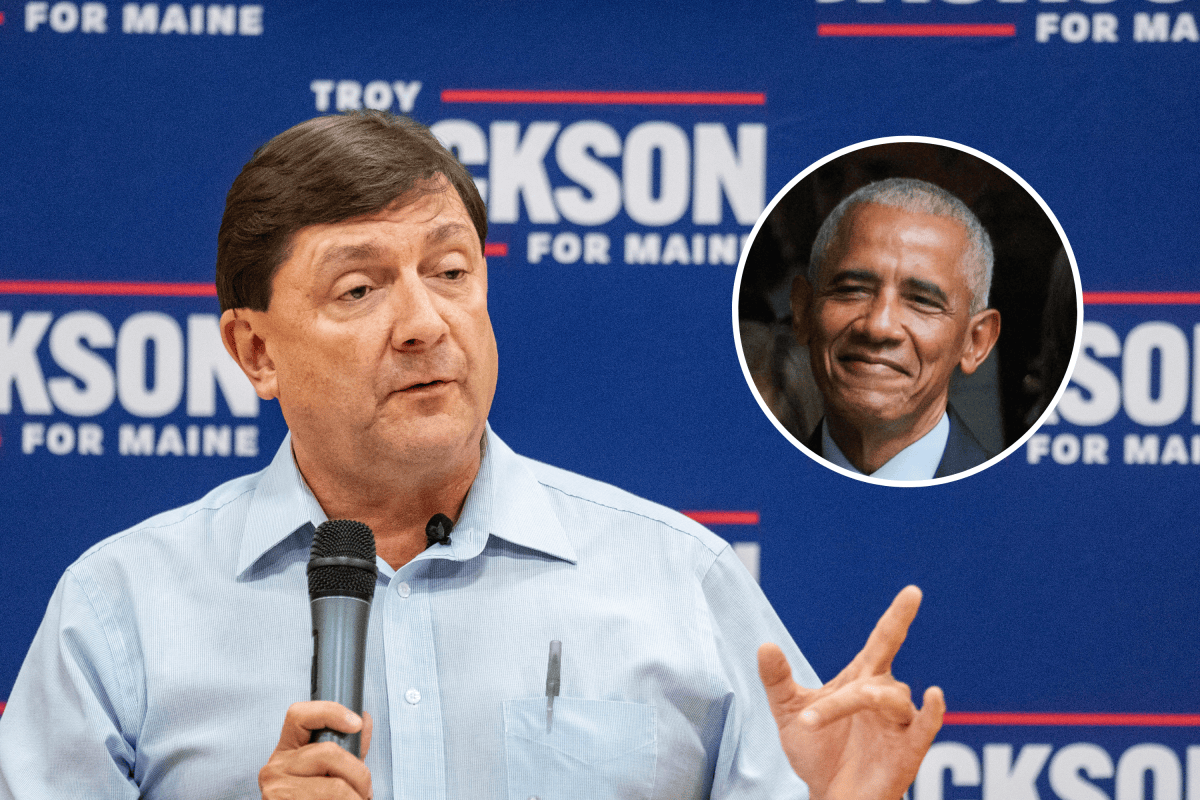
Left-wing streamer Hasan Piker set off a political firestorm after telling Axios this week that the United States has killed more people than al-Qaeda "pound for pound." The comment came during the September 17 episode of The Axios Show. Correspondent Alex Thompson asked Piker point-blank: "You once said that America is the top dog in terrorism. Do you think America then is worse than al Qaeda?" "Pound for pound as far as the number of deaths, yes," Piker answered.
"We have caused tremendous terror all around the world." He pointed to the February 2026 strike on a girls' school in Minab, Iran, which Iranian authorities say killed more than 140 students. "If you're killing 140 schoolgirls, that is an act of terror," he said, adding that he did not "mean that all Americans are terrorists." By the next morning, the clip was everywhere, and the remark set off immediate backlash from both parties. The Republican Party's official account demanded that "every single Democrat" disavow him.
New Jersey Representative Josh Gottheimer, a Democrat, wrote that "comparing America to al-Qaeda wasn't an accident. Piker has built a brand on anti-American hate." While Michigan Senate candidate Mike Rogers, a Republican, tried to tie the remark to Democratic candidate Abdul El-Sayed, closely tied with Piker, Piker responded that he did not "agree with this statement" and gave "much weight to the statements made by a social media streamer." Piker, who faced similar criticism after saying on Twitch in 2019 that "America deserved 9/11," a remark he later called imprecise and walked back, later wrote on X that Axios had turned "a nuanced answer about acts of terror this admin has caused" into "clickbait." The word "terrorism" existed in law and scholarship long before September 11, 2001, but the attacks reshaped how central it became to American politics, policy and everyday language. Nine days after the towers fell, President George W.
Bush stood before Congress and declared a "war on terror," a phrase that would define two decades of U.S. foreign policy, two invasions and a sprawling expansion of federal counterterrorism law and agencies. The word itself, already unsettled in legal and academic circles, took on new political stakes it has never fully shed. Newsweek asked three of the country's leading authorities on terrorism and the laws of war to explain how their fields actually define the term, and where the legal and academic lines fall.
"There is no universally accepted definition of terrorism," Geoffrey Corn, a professor at Texas Tech University School of Law and director of its Center for Military Law and Policy, told Newsweek. Corn spent 21 years as a U.S. Army officer, finishing his military career as the Army's senior law of war advisor.
Usually the government condemning it." A rough consensus does exist, Corn said. Terrorism generally involves "the use of unlawful violence, usually intentionally targeting people or things, to influence the policies and actions of governments or to simply spread terror." Bruce Hoffman, a Georgetown University professor and author of Inside Terrorism, a book that has stayed in print for nearly 30 years, defines it somewhat differently: "the deliberate creation and exploitation of fear through violence or the threat of violence by non-state actors in the pursuit of political change." "That is more or less the normative definition among scholars," Hoffman said. "The legal definition is not terribly different, but there is no universal consensus or a single agreed upon definition of terrorism." Mary Ellen O'Connell, the Robert and Marion Short Professor of Law at the University of Notre Dame, starts from a different premise than Corn or Hoffman.
Extract — continue reading at the source.