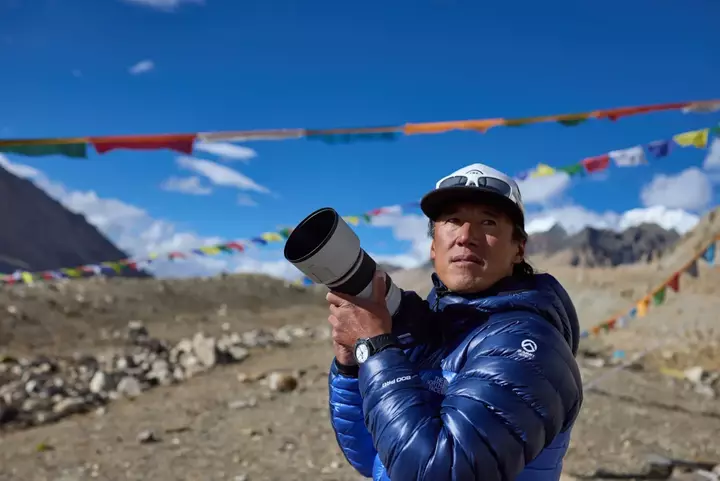
( ummins) When Jimmy Chin was in his twenties, living out of a 1989 Subaru Loyale somewhere between Yosemite and the Tetons, he kept trying to explain climbing to his father. His father, a librarian at Mankato State University in Minnesota, would listen, and then say: “Our language is 5,000 years old, and there is no word for what you do.” Chin has spent the decades since building a vocabulary for it anyway, as a climber, a photographer, and the Oscar-winning director of Free Solo featuring Alex Honnold, and his latest film, Everest: The Other Side, which documents Jim Morrison and Hilaree Nelson’s attempt to climb and ski down the North Face of the world’s tallest mountain. His new book, Rules to Live By (Celadon), presents other people’s words, but is also part memoir.
It’s built from ten conversations with people who have lived on their own terms: Yvon Chouinard, Yo-Yo Ma, Simone Biles, Ridley Scott, Kelly Slater, Annette Bening, Lynsey Addario, Kris Tompkins, Alex Honnold, and Bill King, a retired command master chief of SEAL Team 6. He asks each of them some version of the same question: In the end, what really matters? And in the end, we learn what matters most to Jimmy Chin as well.
Earlier this month, I sat down with Chin onstage at the Bell House in Brooklyn. It was his first book event, and he confessed he hadn’t reread the book since turning it in. The conversation has been edited and condensed.
OUTSIDE: You write that you’re “the only son of an only son of an only son.” That sounds like a lot of pressure. Jimmy Chin: I started violin when I was three, and it became two hours of practice a day. Then martial arts, two hours a day.
That was my weekdays, and it was all I knew. But I learned discipline, and there was a very high expectation for excellence. My dad always said, “If you’re going to do it, you might as well do it well.” I hated that.
Sometimes I still struggle with it. There’s a scene in the book where you’re practicing violin, staring out the window at the forest. Chin: Anytime I did well in school, my reward was running off into the woods.
Extract — continue reading at the source.