This week, Syria's Kurdish minority agreed to dissolve what had been their almost 14-year-long experiment in independent rule. During the Syrian civil war, which began in 2011, the Kurds consolidated their authority over a large part of northeastern Syria, and wanted to maintain that after the civil war ended. But as Kurdish leader Mazloum Abdi said this week, "circumstances have changed." Kurdish fighting forces, which go by the name of the Syrian Democratic Forces, or SDF, will now be integrated into the general Syrian military, and the oil-rich area they ruled will come under the authority of the central government.
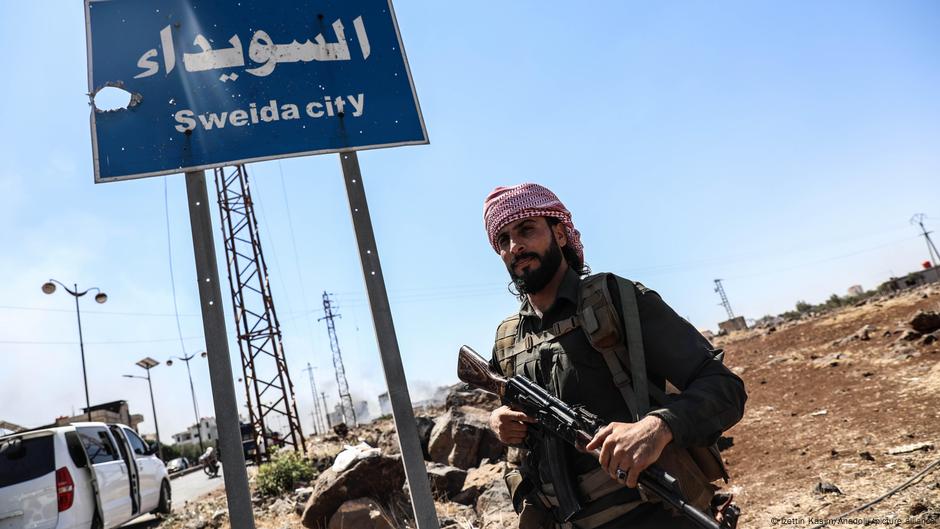
All this means that Sweida province, home to much of Syria's Druze minority, is now the only area not to have accepted the authority of the central government. There is no doubt that the change in the situation with Syria's Kurdish community will affect what is happening in Sweida, experts say. When Omer Ozkizilcik, a nonresident senior fellow at US think tank, the Atlantic Council's Syria Project, met with Sheikh Hikmat al-Hijri in early 2025, the Druze leader said he was in daily phone contact with Abdi.
"He said that they were coordinating all their efforts and that they had a similar political vision for Syria — that is, decentralized with autonomous regions," said Ozkizilcik. "He basically repeated the Israeli approach, where they believe Syria should be divided, with an autonomous zone on the coast for the Alawite [minority], for the SDF in the northeast, and then in the south for the Druze. That shows that al-Hijiri's political vision was highly dependent on his alliance with the SDF." That idea is no longer feasible.
"Basically it puts an end to this vision of a fragmented, weak and decentralized Syria," the Ankara-based analyst argued. That is also probably the reason why, earlier this week, al-Hijri again emphasized the Druze ties to Israel, Ozkizilcik suggested. On Monday in Sweida, al-Hijiri declared the Druze an "inseparable part of the state of Israel." "Even in terms of our beliefs, we share common ground," he said. But it's clear that having Israel annex Sweida would be very difficult for a number of reasons, including geography and demographics.
Sweida is also still dependent on the central Syrian government. Despite it being impossible for government forces to enter the area, Sweida still receives public services, salaries, pensions, power and water from Damascus. The exclusion of government forces began after intercommunal violence in Sweida in July 2025.
Fighting started between Druze and Bedouin locals. Government forces arrived, ostensibly to quell the violence, but they too were then accused of attacking Druze communities. A report by the United Nations found over 1,700 people died as a result of the clashes.
Extract — continue reading at the source.