I am sitting in a frost pocket in West Virginia, looking at a Canada warbler. It is World Migratory Bird Day in spring, the second Saturday of May, and I have spent the past week in search of warblers. The Appalachian Mountains roll out a green carpet for songbirds making their annual migration between the winter warmth of Central and South America and the northern habitats they need to breed and nest.
Some birds will pass through and continue on to the boreal forests of Canada; this warbler might be one of them. Some birds find their sweet spot along the 2,000 miles of mountain ridges that flow southwest to northeast. Their route traces the compressed, parallel spines of ancient rock, a corrugated topography of knobs and hollers.
As the land dips and rises, these small travelers find their comfort zone in the microclimate and plant communities that suit them best. I have a moment of spatial and temporal dislocation: I could be much farther north, or I could be watching a landscape emerging from the last ice age. To follow the birds, I follow the geography, which led me to the Cranberry Glades Botanical Area, a peatland nestled in the Monongahela National Forest.
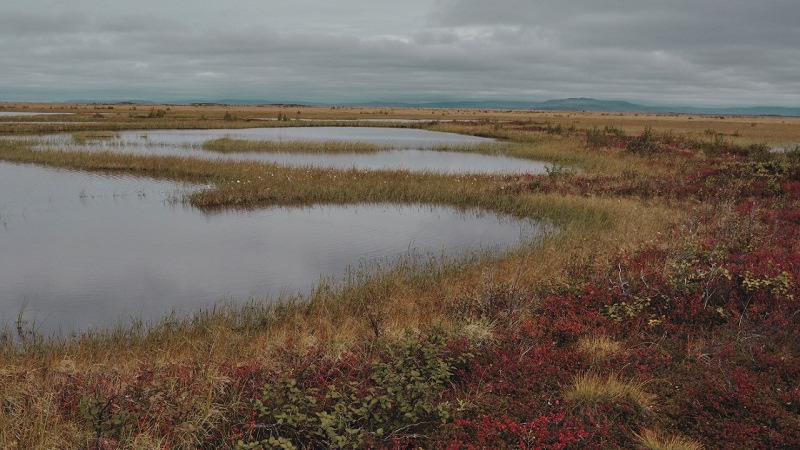
The protected area encompasses an assemblage of peat bogs that resemble the muskegs of northern Canada. At 3,400 feet in the Allegheny Mountains, the Glades exist in a place where cold air sinks from the surrounding mountain slopes into low hollows—aptly called frost pockets. These pockets create the climate conditions that sustain plant species more commonly found in the boreal north, survivors from colder times long past.
This dense, wet habitat is where the Canada warblers feel at home. The Glades are warming up to spring, still swathed in dried sedges from last fall. The word “glade” comes from Middle English, or Old English “gloed,” meaning a bright, sunny place, a clearing in a forest.
I enter a boardwalk that makes a looping path along the edge of Round Glade, through a dense patch of alders and giant rhododendron, and past a corner of Flag Glade. The wooden walkway is weathered and warped; unlike elevated boardwalks in other peatlands I’ve visited, this one sits nestled directly on the uneven terrain of the bog. The Glades are lush with Sphagnum mosses, black chokeberry, skunk cabbage, and a creeping mat of teaberry.
Extract — continue reading at the source.